Showing posts with label Perfecting Sourdough. Show all posts

Sunday, 18 March 2018

Sunflower Sourdough twice

Having completed in principle one tour through all the sourdough recipes in Jane Mason's book: Perfecting Sourdough, we are now baking different recipes suggested up by members of the Facebook group.

I last baked and posted about the Sourdough Sunflower breads last July when it was particularly hot.  Today its been snowing, and since we were not venturing from home, this weekend has been one of baking, reading, research etc.

I set the sunflower seeds to soak, and the mother sourdough to prove overnight with a feed as per the recipe.  We have been discussing how to get a much tighter loaf, and various ways of getting a better shape on our loaves.  I also discussed bread making with my friend Marie-Claire whom I initially taught how to make bread.  Now with her many self taught bread making skills, we like to chat over the phone about bread matters.  We discussed the very helpful shaping techniques on u tube and I found Bake with Jack which she recommended as being fun to watch and follow.

I was not quite on the ball on Friday...weighed twice the amount of sunflower seeds, was busy moving plants around to more protected zones in anticipation of the snow...and forgot to reduce the temperature after the initial hot blast at 230 C.  I only moved the loaves round, but I managed to whip the loaves out after 25 minutes.  The crust is lovely dark and very tasty and because there is such a high hydration, the bread is not at all dry.

 As usual I like to bake two smaller loaves.

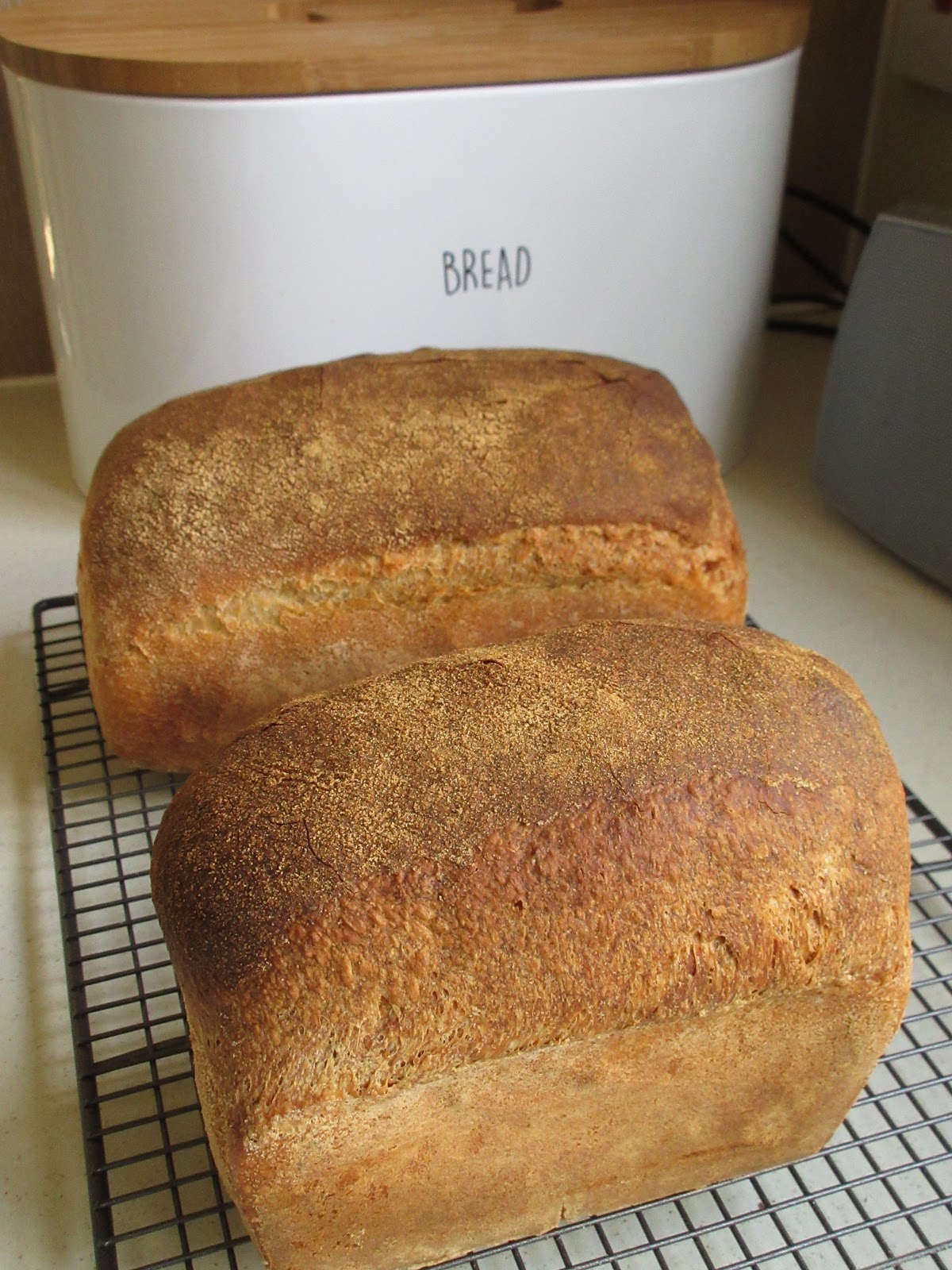
The same recipe was followed today...but I tried the loaf baked in my stainless steel roasting dish.  This technique works really well for me....It gives a really good and even rise and colour...I heat the roasting tin in the oven, and follow all the same temperatures, but remove the lid or rather the base, since I use the tin upside down, for the final 15 minutes baking.  I have even seen an old pyrex dish used to bake bread in.  Next time I am going to try using my stainless steel mixing bowl as the covering dome.  My shelves can only accommodate one covered dish on one level with another shelf with just the oven tray.  I think the oval loaf is my best sourdough so far.

The freezer is now well stocked up with bread...sofor the next week or so when the weather improves I shall have bread, and with weather improving time to go out and tackle the garden and continue with gloss painting!

Wednesday, 7 March 2018

Rosemary Sourdough Bread - Perfecting sourdough by Jane Mason

This is the last of the recipes in 'Perfecting Sourdough' in the long list set for the Facebook Page.  I have baked almost all of them, those I missed out were because we were moving or had the house totally upside down.  I kept this recipe to be the last one as I love the association of herbs and plants and Rosemary is for Remembrance, and the picture of this loaf is also repeated at the end of the book.

Both my wheat and rye sourdough starters are really reliable.  I refresh them every three weeks or so, and often use them to top up other standard yeast bakes I may be making.  This was one of the tips my fellow moderator Nigel.  Another trick I have tried at last with this loaf, was baking in a closed roasting tin...similar to using a dutch oven.

I have also learnt and understand how the dough feels when it has been sufficiently kneaded, seen how folding at intervals really does help the dough to stand up.  What I still feel lacking in confidence is the turning out and slashing.  Some times I feel confident and go ahead, if not, I just use baking tins...the bread tastes equally good.

I started the refreshment part of the starter mid morning, when I also set the raisins to soak in the remaining water together with the chopped rosemary from the garden.  This meant the water had taken on some of the sweetness of the raisins and the rosemary. 

By 6 pm the starter was bouncy and ready to go.  Before dinner I set to kneading the dough.  Not quite according to the instructions, but following Jane's technique from the book of buns, the fat was added after the initial 10 minutes, and then I folded the raisins and rosemary, before the bulk fermentation.

Last thing I divided the dough into two and set them in cloth lined bannetons, covered them with their 'shower caps', and left them in the cool kitchen.  By six the next morning, I had a peep and were they more or less ready...but I wasn't, so they went into the fridge.

As soon as I was properly awake and the oven hot enough, out came the first loaf from the fridge, it was very light and airy, and I was concerned that it may have been just a little too far gone. So I just brushed it with egg and didn't score it.  I'm pleased I used the Bannetons with their cloth liners as that made them easier to turn out.

I watched it rise, and decided to try the technique of baking the second loaf in a closed container.  I have an oval stainless steel roasting dish with a lid which I used.  I am so pleased that Jane Mason recently gave guidance on turning out the loaf onto a large sheet of baking parchment, then using the paper to manoeuvre it into the tin. 

Not actually being able to peer at the loaf rising through the window in the oven seemed disconcerting at first, so I was totally relieved when it was time to take off the lid for the final fifteen minutes of baking.  The loaf look marvelous, and felt really light when it was ready to be turned out and left to cool.  It felt lighter than the loaf baked on the baking sheet, even though it was bigger.  I put them on the scales and it was actually heavier but felt ligther and spongier in the hand.


We don't usually eat anything in-between meals, but I could not resist a slice when it was time for coffee, and Mr S definitely did not want to left out.  The aroma, taste and mouth feel were bliss.


Perfect with goat's cheese and grapes.  Lunch was just soup and fruit....


Some of the recipes I have now baked many times, as they are so easy.  My favourites are Do Good Loaf, Mixed grain Sourdough and all the ones based on Rye Starters particularly Finnish Rye.  The 100% wholewheat is amazing, and whenever I buy craft Stoneground flour, bought on my visits to mills, this is the one I use to really get the full flavour of the wheat.  Often I scale up the recipe to yield two or three loaves, which are either shared with friends or frozen.  With options within the recipes for different flours, sweeteners and fat, there are even several variations of most to be tried.

From starting in May 2016 I feel that my sourdough technique has really Improved...not perfect, I just 'knead to keep at it'!


Friday, 23 February 2018

Bacon, Cheddar and Jalapeno Loaf


The recipe for this loaf is on page 122 of Jane Mason's Book Perfecting Sourdough.  However I made a few variations.  Due to issues with consuming cow's milk, I went for goat's cheese made at the farm in Wookey. I have only had to travel a short distance from Cheddar too!  I'm just having a bit of a smirk as I think about this, as I am sure most people won't be using Cheddar Cheese from Cheddar!


For the chilli I used some chopped up yellow chilli which had been in the freezer since last year when a new friend Tiana had passed a few to me.


The only other change I made was that I set the finished dough to rise in a large cake tin.  I ought to have set the dough in a large 1Kg proving basket...but I felt happier not doing the turning out thing this time.

The bread smelled divine as it was baking, and formed the basis of lunches with soups and salads, and I found Mr S snuffling up a just a bare slice for his supper!


The flavour and texture of the loaf is excellent...but next time I would bake two 500g loaves and freeze one.  This is the first time I have had hot chilli peppers in a loaf, and probably would not have baked this loaf if I had not been in the Facebook group baking through all the recipes in this book.  However now that I have read about the Jalapeno Pepper, I am even willing to grow my own.   A few years back I was growing small red chillis and this was hugely productive.


In my view all manner of additions could be added to this dough...olives, spring onions....but then there are lots of other savoury loaf recipes in 'Perfecting Sourdough'.


Saturday, 10 February 2018

Cheese and Onion Sourdough Bread

It seems ages since I had my hand in sourdough, and having refreshed the starter last night, I set about one of the baking challenges set this month.

At the same time I made up something that approximates to Do-good Bread, divided  into a loaf, and some mixed up with soaked up bottom of the bag fruit and fibre cereal with added fruit.  Its one of the ways I use up all the fine stuff left at the bottom of the cereal bag!  We end up with breakfast bread that uses up what would have been wasted.  Our wild birds prefer sunflower hearts to left over cereal!

As I write this up, the smell of the cheese and onion loaves, slowly cooling on the rack, is wafting upstairs. Supper this evening will be this bread together with a warming and spicy soup.  We had a altogether delicious and filling lunch, and this will do very nicely indeed.

The recipe gives a 1.4 Kg loaf, which would be great for a gathering.   I therefore chose to make two smaller loaves, and feeling that my dough would slide across the baking sheets during its two to three hours final proof, used two deep pan  baking tins. 

As for the 200g mature Cheddar Cheese, this was not on the cards for us.  Such a shame as Cheddar is just down the road...Instead I thought some goat's cheese from a farm even closer at Wookey, bought straight from the farmer at the Wells's farmers' market on Wednesday would do very nicely.  It came wrapped in grease proof paper..so absolutely no plastic in this instance!


Once the dough was ready for its final rise, it was popped into tins...


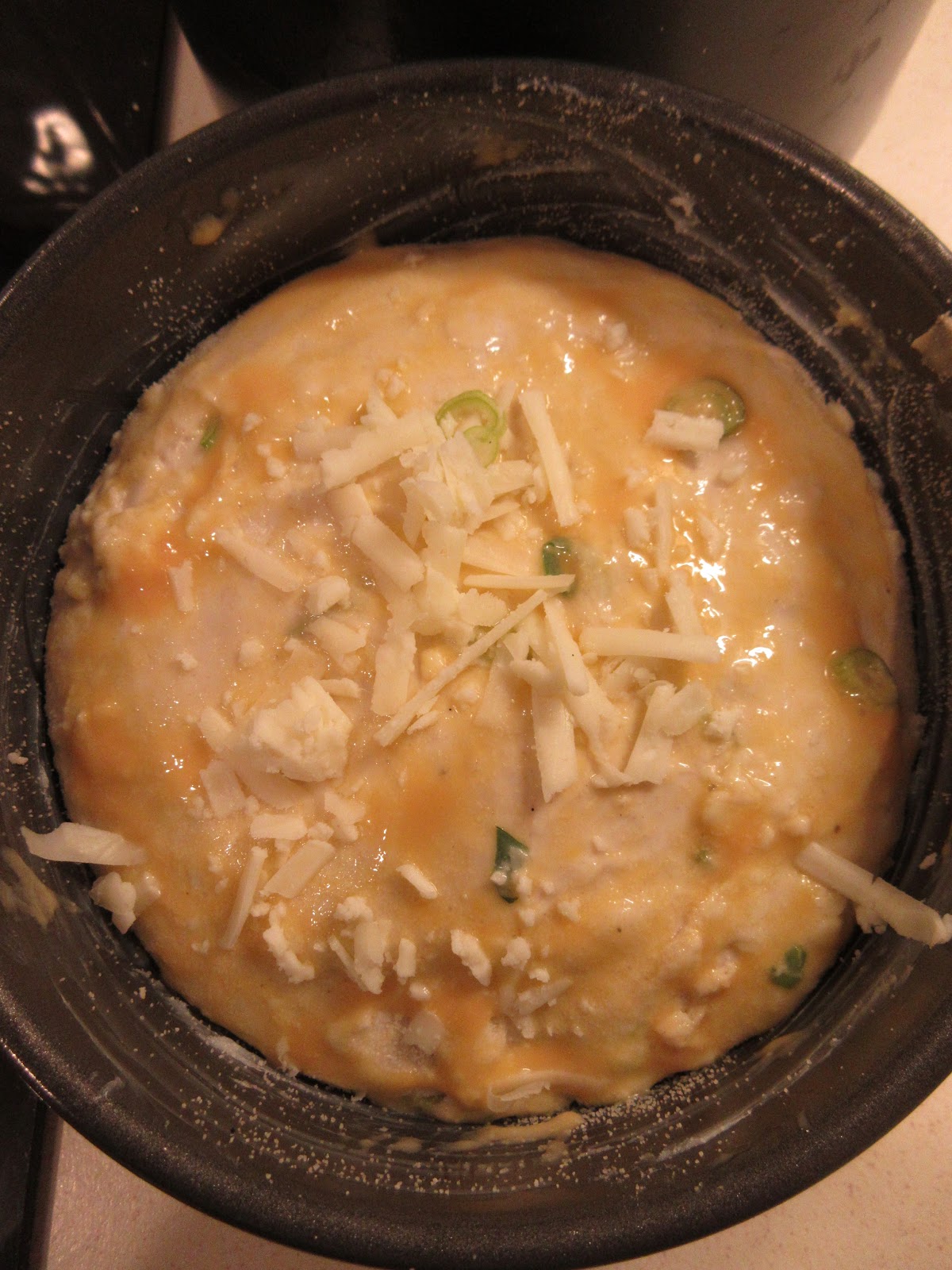
and after about two hours I brushed them with egg wash and added just a small sprinkling of cheese.


Then after another hour...I felt they were ready for the oven.  After the first blast I decided to sit out in the kitchen and watch the loaves carefully through the oven window and was happy that the cheese did not burn.

Here they are turned out and cooling....


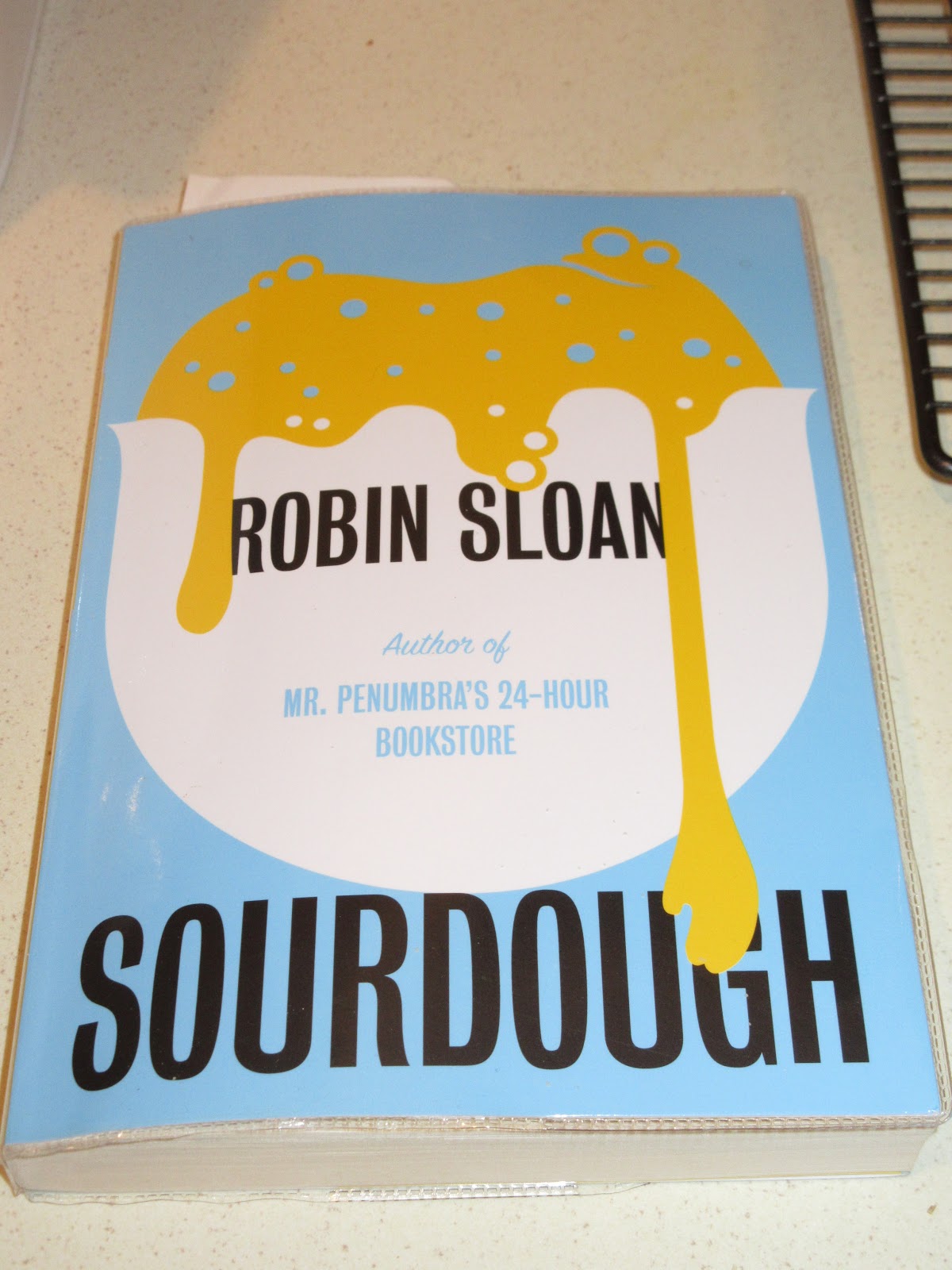
When I popped into the library this week...out on the New Books stand I found this one.  Of course, I was drawn by the title...and I have found it entertaining and amusing and read about Lois being shortlisted, or not for a market stall in San Francisco.  Nice to have a novel with a character who is beguiled by sourdough!


Off to heat up the soup now.....

Sunday, 10 December 2017

Cranberry and Nut sourdough Loaf

This is one the December 2017 baking challenges from Jane Mason's Book: Perfecting Sourdough.

I doubled up on the bulk fermentation ingredients, then make half with dried cranberries and pecan nuts, and the second one with hazelnuts and raisins.  For the flours I used a mix of half and half white strong wheat, and creamy spelt.

As always the nuts were first baked a little in the oven till smelling and light golden, then with the fruit they were soaked in some of the liquid overnight, whilst the sourdough from the fridge had its overnight refresh.

These loaves took a very long time to rise, most probably because it was so cool.  They are meant to rise in proving baskets, but I felt more confident using tins for this dough.

They were shaped up and put into tins around 15:30 on Saturday, and by 18:00 still were not ready, so they went into the very cool conservatory for an overnight 'refrigerated' rise...but at 6:00 am they still were not high enough in the tin.  Having been brought them back into the kitchen then, and having been given a boost by sitting on top of the cooling toaster from breakfast, they finally went into the oven at about 11:00 am.


The Cranberry and Pecan Nut loaf is now in the freezer, and will come out for Christmas morning breakfast...but I could not resist cutting into the hazelnut and raisin loaf:


The flavour is topnotch, with hazelnuts warm and mellow, and the raisins soft and tangy in contrast..spread with a little butter and thick honey, then have made a tasty snack with Sunday afternoon tea.

Tuesday, 28 November 2017

Pumpernickel Rye from Perfecting Sourdough

For this loaf, I used regular wholemeal rye flour as an alternative to the coarsely ground specialist rye pumpernickel flour.  As Mr S has definitely said that he did not want any more caraway seed, I substituted this for fennel seeds.  I followed Jane Mason's recipe from #Perfecting Sourdough where she recommends soaking the seeds overnight in some water.  To give this loaf a little texture, in the soaking water I added some rye berry flakes and a handful of pumpkin seeds.

The dough was rather sticky so kneaded it in the mixing bowl, which worked rather well.  This is probably the sort of dough which, had I had a table top mixer, would have preferred to mix this in a machine.

Looking at the size of the dough, I felt that my standard 500g loaf tins would have been a little small, so opted to use the Silverwood tin, which in my opinion needs about 750g to 800g dough.  As I have been finding turning out long proving baked sourdoughs from steel tins a little tricky recently, I also lined the tin with some baking parchment, as well as buttering it.  This worked rather well.


With molasses in the dough, it is obvious that the finished loaf would be on the dark side, but I think this time the loaf was a little overbaked.  I should have noted this as the loaf was well shrunk from the sides by the end of the baking time. Not to worry, it is getting softer since it has cooled, and given that sourdough bread is probably best kept for a day or two before cutting, there will be a good flavour.


I think the Silverwood tins transfer the heat very efficiently compared to my black heavy non stick tins, and next time will omit placing then on a preheated baking tray.  I usually bake tins on on preheated baking tray which helps the bottom of the loaves bake well.

Saturday, 11 November 2017

Beijing sesame buns or Shaobing for Sourdough Saturday

I knew the weather was going to be soggy today, which is why I have put off meeting with a friend to do a tour of the Christmas Fair at Well's Bishops Palace until tomorrow.  One of the best things I can think of in the way of 'distractions' on a bad weather day is a spot of baking, and since sourdough can take most of the day...its the night before that one has to prepare by reinvigorating the sourdough starter.

This morning my big bowl of sourdough was frothing away, ready to be used.   Following the recipe in 'Perfecting Sourdough' by Jane Mason, for Beijong Sesame Buns, set as one of this month's baking challenges, I substituted peanut butter for the roasted sesame paste.  In no way do I imagine that these would pass the test by a Beijing Sesame bun connoisseur!  For one I used a little walnut oil instead of sesame oil to lubricate the laying of the peanut butter, and I substituted the pinch of salt on the layer of peanut butter for a little sugar.

They were a bit tricky to shape, but I was not in a hurry, and got there in the end.  They came out as it said in the recipe: crisp on the outside and tender on the inside.


There are layers within the bun, and quite nice with our afternoon cup of tea.  Sometimes when having a completely new tasting bun with a different texture I am not always bowled over.


I may feel differently when having my second or third bun!  But for now, they will be going into the freezer and taken out to have occasionally over the next couple of weeks.

We needed some bread so I experimented with some white flour to which I added some maize polenta...to be cut at breakfast time tomorrow. Two 500g loaves the sourdough way of course!


Thursday, 12 October 2017

Basic Sourdough Batter Bread

Again another bake from Perfecting Sourdough.  From its title you would expect this to be a ...basic...bread.  Well it didn't turn out that way, I would describe it as 'a tea loaf the sourdough way'  With the following ingredients:

65g wheat sourdough starter
345g white spelt
65g water
100g cold pressed rapeseed oil
100g sugar
120g milk
1 egg
3/4 tsp baking powder

Like another member of the Facebook group, I felt with the sweetness it cried out for some fruit.  I added a couple of my small fistfuls of raisins.

I chose to line the tin with baking parchment, as it was loose bottomed, and with the long rise to the batter, I wondered whether it would ooze out of the bottom otherwise.  There is no kneading at all with this one, and therefore the texture was definitely cake like, more so since spelt has that soft melty mouth feel even in a well kneaded loaf.


My first taste left me a little underwhelmed.  I thought it would be much more tangy with all the long standing...it took somewhere around five hours rather than the three suggested, even though my refreshed starter was almost jumping out of the bowl in the morning.

However on the following day, sliced with butter and jam, it was rather good.  I froze half the loaf, and have had a piece on day 2, 3, and four, when it is still a lovely treat with a drink of coffee.  It has grown on me.  I think next time I may add some spice, and other items, and making this loaf has given me the confidence to try variations of this 'sourdough tea loaf'.


Thursday, 21 September 2017

Caraway Spelt

The Caraway Spelt Loaf based on the rye sourdough starter is from Jane Mason's Book: Perfecting Sourdough.  I scaled up the ingredients so that I could shape the dough into 2 loaves in my 500g proving baskets.  The loaves turned out beautifully and one of them came with us to Bath.


Here is Millie...I am sure she could smell the delicious aroma as I was cutting the loaf to go with our soup.  I am sure that she would not have objected to the caraway seed has she been offered a piece.  Mr S has quite firmly suggested that I use another seed and he said that fennel would do!


Peasant Bread by Jane Mason

This recipe is based on a rye sourdough starter and is a breeze to make, and absolutely delicious.  It will certainly be in my go too recipes for regular baking.  It is on page 53 of Perfecting Sourdough by Jane Mason and is one of the two recipes this month chosen for the Facebook Group, both based on a rye starter.

This sourdough loaf is particularly easy as there is no bulk fermentation and no turning out from proving baskets.  I have found that reviving the sourdough starter from the fridge, with part of the flours and liquids on the evening before baking, and leaving this to do its job on the kitchen counter overnight, works perfectly for me.

In the morning all the ingredients come together, and after kneading for around ten minutes, the dough is shaped into a round disk, put into a round cake tin, and left to prove.  Maybe because the weather is turning autumnal and a little cooler it took 6 hours to rise rather than the 3 to 5 given in the recipe.  There was plenty of time to cycle to the market and get on with doing some gardening!


My loaf did not have quite the lovely overall white dusting of flour, so perhaps next time I will sift the white flour over just before baking rather than as I set the dough to prove. As I brought the various ingredients together I wondered what the 1tsp ground coriander would bring as a taste note.  I cannot taste it, but the loaf is so rich and flavoursome, it must have added a layer to the flavours from the wholemeal stoneground flour from Dunster Mill, and the molasses.


Tuesday, 22 August 2017

Mixed Grain Bread the Sourdough Way


Another wonderful smelling bake from this month's challenge:  Mixed Grain Bread.  With white and wholemeal spelt, and white flour, honey,  fennel and caraway, and a very lively sourdough starter, these loaves are sure to taste nice.

However...I doubled on the recipe, but I think I put a little too much dough in the larger tin, and also I think they were about 20 minutes over proven.  Its warm and humid today, so setting the timer for a final two hour rise, and going off to do something else, was bound to lead to  'I wish I had gone to check sooner feeling'! 


Although on the recipe it gives a 500g bread tin as the container, the picture facing shows some little loaves cooling, so this is why there are three smaller loaves and a large one.  Next time I shall make dough for four small tins and the larger one.

I played at filling all my different tins with water this morning, and weighing them, and then calculating how much dough each one should hold.  Now I have a formula for working out the correct amount of ingredients to give the dough weights I need.  Well I have to put to good use all those maths lessons!!!!!

Wednesday, 9 August 2017

Kamut Bread the sourdough way

This is one of the loaves we are baking on the Facebook Group.  I do rather like Kamut flour or as it is also known: Khorasan flour. I used to get this flour as part of my order from Shipton Mill, and even posted a recipe for Khorasan  Breakfast Buns quite some time ago on their site.

This time I quickly picked up a bag of Dove's Farm Kamut flour from a local supermarket.


My starter was healthy and bubbling, and as usual I had upscaled the ingredients to make two loaves.


and the soft golden colour of the Kamut Flour was silky smooth in the kneading.  I followed the recipe, and everything looked fine....until I looked at the loaves rising in the oven, each on their own shelves.  I knew straight away that it would the tale of the good, the bad and the ugly!  The recipe is good, the baker had a bad technique: turning out the dough from the baskets was problematic with 'ugly' results!


When I cut into the loaf, it rather looked like one of the caves in Wookey Hole.  Mr S had thought of getting one of his n guauge scale figures to stand in this huge hole.  However, we were desperate to start our lunch!


Non of the loaves were wasted.  We ate the more reasonable slices, and the rest got made into a rather delicious bread pudding...enriched with egg, milk, raisins, peel, spices etc.

Yesterday I attempted the recipe again...but did not feel like having the fight with the baskets, so used bread tins.  The dough was rather lively and gave big rise...no there are no large holes this time.


Friday, 28 July 2017

Sourdough Pizza Base

This is one of our bakes for July from Jane Mason's Book: Perfecting Sourdough.  I had been refreshing my wheat sourdough ready for a couple of white loaves...and had enough to start off the mix yesterday morning.

The recipe says mix 60g wheat sourdough, 140g white wheat flour, 1 tbsp fine semolina, 90g water, 3 g salt, just mix and leave to rest for 12 - 24 hrs. All you then need is some olive oil for dressing, and an assortment of toppings.   Just how easy can it get?  I had planned to make the pizza for lunch today...but once one has Pizza on one's mind, I could find no further inspiration for supper.

Having roasted two large pointed red peppers, in the 'dying embers' of the oven's heat from the sourdough loavews, there was no accommodating the 12 hrs wait.  Four hours short, the dough was dressed with pesto, all the red peppers, red onions and garlic which had not long come out of the oven, with a large gloriously soft and juicy Laverstoke Park Farm Buffalo mozarella which I had bought that morning, torn and spaced oven the top.


With oven set at its highest setting...it wasn't long before supper was ready


I felt this beauty needed to dress for dinner...with some green basil torn from the Kitchen windowsill herb.


I'm already thinking of alternative toppings.....

Wednesday, 19 July 2017

Finnish Rye again.....

When a baking friend posed the question: This is my refreshed starter including the water, rye flour and wheat flour. Does it look the right consistency?  I offered to bake the loaf and take lots of pictures.  I do hope this helps Angela...and it got me thinking carefully through each of the stages which makes up this loaf.

I have now made this recipe more than half a dozen times...it is a pure sourdough loaf, but it has no intermediate bulk rising, and gives a very nice even crumb.    If you want to see what I have posted previously: do go to Finnish Rye and Finnish Rye Again.  During cooler months, I have allowed the dough to rise in the tin at ambient kitchen temps, but as it is now rather warm...ambient day temperature 24 C, I prefer to do the rise during the day when I can keep my eye on the loaf.

For my personal taste I now half the amount of malt syrup, and have used honey this time.

This is the rye sourdough just removed from the fridge at about 9 pm.


I start by weighing into my bowl 25g whole rye flour


Then I weighed in 35g wholewheat spelt


followed by 30g water at room temperature


and finally 35g of the rye sourdough starter from the fridge


when it was mixed up this is what it looked like, before being covered with its shower cap, and left overnight on the kitchen worktop.  It looks just the same as Angela's mixture.


In the morning it was nicely puffed up


On top goes 75g of rye flour

 Then 150g strong white flour
 Then 6g salt

And finally 100g milk, 50g water, and 30g honey


Then I mix it all up by hand in the bowl


It is a fairly sticky dough, most rye flours result in a sticky dough...but no more flour please.  I use my trusty scraper to bring bits off the work surface and into the dough ball at regular intervals during kneading.  This is what it looks like after ten minutes....


I know my 1 lb tins work very well with 500g standard dough or a little more sourdough up to about 550g.  Just to compare with other tins...this tin holds 750g water.  I usually weigh the water held by different tins so that I can scale off the right amount for different tins. By scaling up the amounts in recipes I am able bake more than one loaf using different sized tins.  For example for a tin which holds 1000g water I use 1000 / 750 x 550 = 730g of dough.


Because my tins are a little old..I find I need to grease them very well for these long rise loaves..I use butter and a little layer of rye flakes, and the loaves comes out nicely. I would recommend preparing them before you start to knead, as it is handy to have them ready to pop the dough in, and not have to keep washing one's hands.

Using wet hands, which Jane Mason recommends, makes shaping the dough a breeze..and it is ready to roll in some flakes.  This is not in the recipe but I find it really helps with my tins.


The dough is now in the tin...and will sit rising under its shower cap.


Its just ten minutes to go before the first of the three hours are up...the dough has a long way to go, so I set the timer for another hour, and also another two hours.  I've had this timer for over ten years...and it is an absolute must for me, as I am usually doing several things at any time.  I was sorry to read that Salter have changed their design.  If I needed to get another one I have found one which looks almost exactly the same!


It took six hours rising to get the level of rise I was expecting


The oven was preheated to 230 C, with a baking tray to put the tin onto.  I find this bakes the bottom of the loaf nicely.  After 10 minutes I reduced the temp to 190 C as it is a fan oven.  After 20 minutes, rather than the 30 minutes given in the recipe, the loaf looked cooked.  Usually I find the timings about right, but there may be up to four loaves in the oven...this time there was just the one.  To check if the loaf was baked fully, I used the thermapen: 95 C...and yes, the loaf felt right.  From the amount of oven spring, I think another half an hour rise would have been OK.


Going through the notes made during previous bakes of this recipe, and comparing it with this run through, I realise that with sourdough there can be so many factors leading to variations...usually time variations.  So judgement based on experience is the best guidance, and allowing plenty of time is of the essence!