Showing posts with label New Garden. Show all posts

Thursday, 10 October 2019

Amsonia hubrichtii

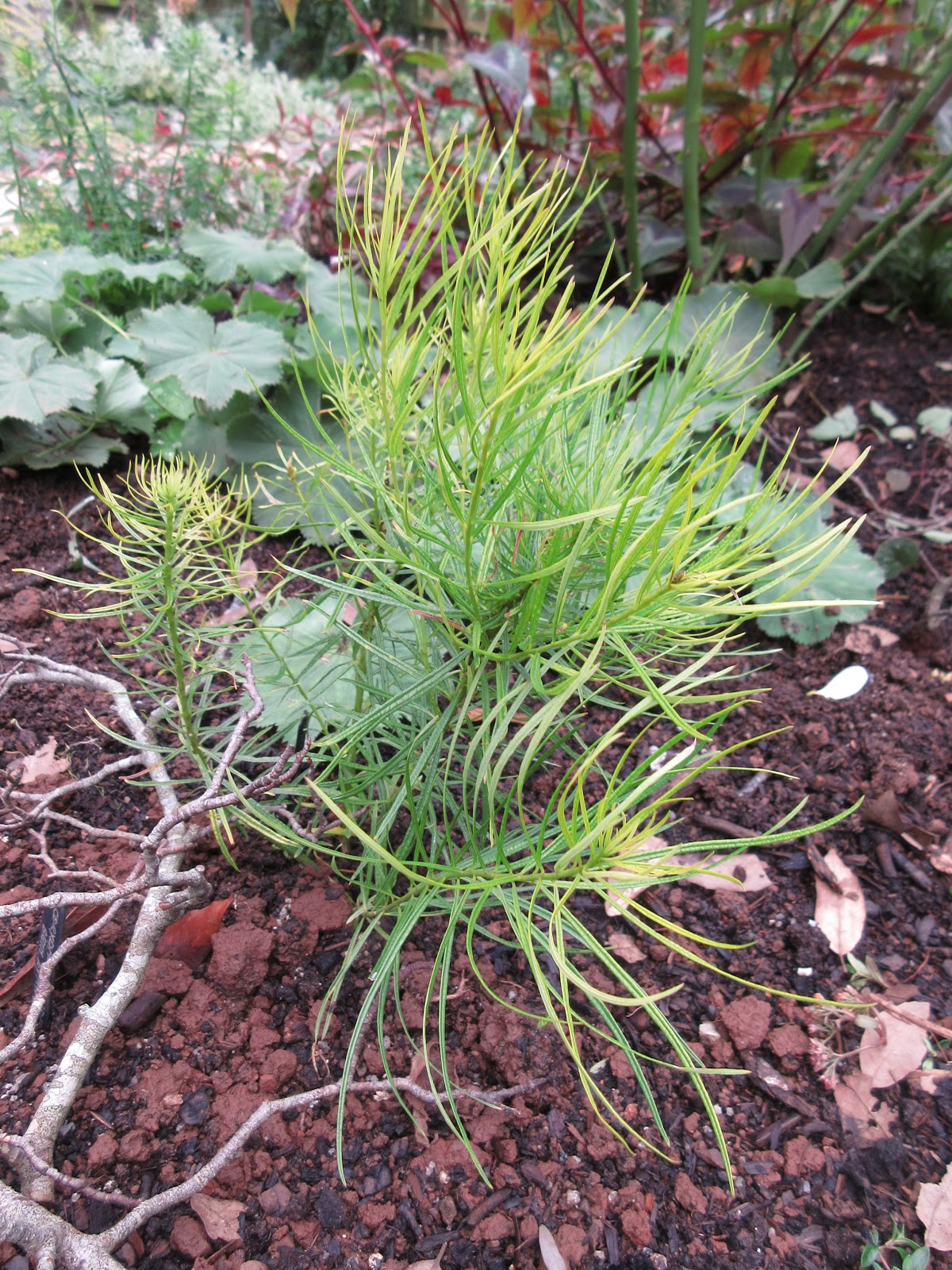
Newly planted in the garden is Amosonia hubrichtii or Hubricht's blue star....


Bought at the Rare Plant Fair at the Bishop's Palace in early September...it is now planted in the Conservatory border in the space vacated by the Sedum Purple Emperor.  Two of the three plants are now out in the front garden.

This Amsonia hurichtii has very finely cut leaves growing up the whole stem, and I am promised clusters of indigo blue buds, opening to grey-blue starry flowers in June. After that the consensus is to cut back to 25cm to encourage fresh growth which will then continue to offer a soft foil for other plants.

I have the autumn butter yellow colour to look forward to in the next few weeks, which will come once we have some frosts.  After that it will die down and then emerge in the Spring time.  In the meantime in that area are other winter and early spring beauties: snowdrops, cyclamen coum and corydalis Beth Evans etc

This plant, also known as as The Arkansas Blue Star  is native to the Ouachita Mountains of central Arkansas, and named after American biologist Leslie Hubricht, who first dicovered it growing in the wild in the 1940s. The whole genus is named in honour of 18th century Virginian physician Dr Charles Amson.

Chicago Botanic Gardens report has a good guide to the American Amsonias.

Saturday, 10 August 2019

Six on Saturday 10 August 2019


I love to start with a little weather report sneaked in...not counting as my six.  At last some significant rain over more than one day, so hopefully there will be no need to fret about watering, and my water butt will have stores for later...however the heavy winds very unlike August will mean for sure time spent removing debris and staking plants.  Luckily I took these pictures before the very heavy winds.

I first admired this allium:  Allium carinatum  subs pulchellum (1), aka Keeled Garlic, in Alison's Garden and was offered a  pot with a few seedlings.  After nurturing and bring these on, for another season in the pot, they were planted out last year, now in August, there is a  fine display of firework like pink blooms.  However they have needed to be propped up with twigs. 

To have a dainty allium performing in high summer with such a quirky form is a small thrill.  The leaves are dying down and perhaps it is on account of the very dry conditions this year.  I also wonder whether because they are at the original depth of the tiny seedlings, about one centimeter down with the tips of the bulbs now above soil level  there has been little anchorage.  When they have finished flowering, the bulbs will be dug up and planted ten centimeters down.  Last year I caught the seeds off the first blooms.  The seedlings emerged, did well, and were re-potted into six pots, but they have now died down.  I'll report again next year on their progress.  Taking this picture has make me consider moving the recently cut down sedum, and planting in its place something that will provide a better contrast to synchronize with the main flowering time of the allium. Any suggestions?

Allium carinatum  subs pulchellum 

On the shed shelf is this Sarracenia, (2).  I bought a couple last December from the market.  One went to my son and this one except for a short spell for a month or so around Christmas in the conservatory, has been outside.  In the strong sun it has coloured up well, but I need to pot it on now.  It stands in water contained by the outer pot.


Sarracenia

At last some rain falling Thursday night and a little during the day on Friday, means that there is water again in the water butt.  Of course the birds visiting the garden much prefer to bathe in rain water, after having to bath in tap water.  Twice a day sometimes whilst watering, the Bird Bath (3)has been topped up. Insects and birds take turn to refresh and drink. 

Bird Bath

The variety of insects this year visiting the garden has expanded.  Leaves being eaten by caterpillars, butterflies and bees drink nectar, and ants are farming blackfly, beetles scuttle around.  Even without a pond, dragon flies are landing in the garden...here one is resting on Origanum laevigatum  Herrenhausen (4).  This was planted as a small 10cm potted plant last August and this year it and the smaller offshoot taken early this year are performing well and all the origanums are visited by bees, hover flies etc.


I love sedums...or at least I thought I did.  I still do but I guess that is so much easier whispering I love all you lovely sedums than saying that I love Hylotelephiums....but if a good friend changes their name, is it not good manners to learn their new one?  There are so many different forms, and over the years I have grown not only to love them, but bought a few different types, and increased them from cuttings.  This one was bought a couple of years ago, suffered from rotting at the soil level soon after planting in ground too rich for them, but I salvaged the stems, made up cuttings and got three plants, which were planted out in the Conservatory border earlier this year.  Now I have to learn the new names of Hylotelephium telephium, but for evermore I shall call this one to 'Purple Emperor' (5)!

Purple Emperor


Ballota pseudodictamnus(6) is another favourite and the plant bought last year at the Autumn Rare plant sale at the Bishop's Palace is growing well, even after its short back and sides earlier in June after its first flourish.  It has looked good all the year round remaining evergreen, in our mild winter.  In the foreground is a cutting taken and poked straight in the ground in January this year, flourishing with its first set of flowers. I find the cuttings very easy, and one taken in early June, is already rooted...that one was pushed into the ground in the shady border.  Of course loving full sun, now that it has rained, the small rooted plant not in view here, will need to be moved.  Where is that ladder? *  These have not been watered during the long dry spell.

Ballota pseudodictamnus

Looking forward to more gardening and seeing what other SOS contributors have on offer.

Saturday, 26 January 2019

Phlomis fruticosa 'Bourgaei'

One of the group of plants I particularly like are the Phlomis.  I first grew a pink shrubby Italica as well as the yellow fruticosa, on a steeply sloping dry bank, and have continued to be drawn to this plant.  Whether on holiday in Crete, Cyprus, and other places within the Mediterranean, I play spot the phlomis!  

Currently in my garden I have Phlomis purpurea Matagalio  growing as strong bushes direct in the ground.   I grew these  from seed sown last year. The quickly expanding clump of herbaceous Phlomis russeliana has lovely erect stems of yellow flowers in the Summer,but will probably need to reduced.

I saw this new shrub in the market on Wednesday, and have spent several days thinking about it.  Today there were still a couple of specimens left, and not surprisingly one had to come home.  The label reads Phlomis fruticosa Bourgaie...but I believe the label was probably printed in Holland.  The name appearing mostly on the internet is Phlomis fruticosa Bourgaei.  There is very little written about this plant, and I hope that my appeal to the holder of the National Collection of Phlomis will bring more information.


What appealed to me with this cultivar, was the shape of the leaf which is elongated, with a fine undulating margin which shows up silvery compared to the grey green leaf surface.


I realise that this plant has probably been cossetted and brought on to look this good in January.  Non the less I am rather pleased to have this to add to my dry and sunny garden, as once it is established, like other phlomis will be drought tolerant.

I share with you the best information to date on Phlomis fruticosa Bourgaei

I was intrigued by this cultivar and wanted to know more.  I got in contact with Beth Smith who holds the National Collection of Phlomis, and she kindly researched this and sent me the following:

 "Glad to hear of your love of Phlomis!  P. bourgaei is named in honour of 
Eugene Bourgaeu (1813-1877).  It's endemic to Turkey from sea level to 
1000m.    It is not a fruticosa cultivar but a separate species.   
Phlomis are notoriously difficult to ID.  We are inclined to think that 
you have a new Dutch cultivar, lazily named.  Maybe one parent is P. 
longifolia - long, narrow, rugose leaves.  Is the other parent P. 
leucophracta?  That would account for the greyish, soft, leaves and 
their curled margins.   We are uncertain and making enquiries from a 
Dutch contact.  I'll write again as soon as I can."


In addition should I get drawn hook' line and sinker into this group of plants and want to learn more, Beth's advice regarding books on Phlomis : "only one in existence has been a great help and was produced by the former NC Holder:

Phlomis:  The Neglected Genus, Jim Mann Taylor, published 1988 by the (former)  NCCPG, now Plant Heritage.   ISBN 0 9532413 0 0     It is out of print but can be obtained as a Book on Demand from Lulu or is available on line as a pdf.   


Just in case I received even more information I contacted the RHS who gives advice to members, using their on line advice system:


More information about the variety, breeding, origin etc

I have grown other Phlomis, but when I saw this plant, I knew I had to get it!!! It has longish leaves, covered in grey fine hairs, typical of Phlomis. The leaves are elongated with a soft wavy edge which I had not seen in other shrubby Phlomis. The label gives Phlomis fruticosa Bourgaei and there is not much on the internet except for a couple of posts from Europe. What does Bourgaei stand for and mean? What is the history of this cultivar and where did it come from? I presume that it would have similar cultivation requirements to other Phlomis...sunny, very well drained, drought tolerant etc. I shall attach photographs...no open flowers till later in the summer I am sure, but I can send you some later if necessary. I have just bought it....

This is the answer I received:
Phlomis bourgaei is named in honour of Eugene Bourgeau (1813-1877), French botanical traveller, who collected in France, Spain, Corsica, North Africa, Asia Minor and North America.  It is recognised by Kew and the RHS as a species distinct from P. fruticosa.  It native range is E. Aegean Islands to SW Turkey.
In the wild it is a yellow-flowered shrub (corolla 20-30mm) to 150cm, found in machis shrubland, oak scrub, and pine woods, on calcareous and serpentine rocks.  There is little written about it from a gardening point of view – I did not find it in RHS books but if you can track down copies of The Mediterranean Garden Society Journal, the Index has references to volumes: 40 (pp. 42, 43); 72 (p. 13); 73 (p. 13).
Cultivation requirements would be similar to those for Phlomis fruticosa ie fertile, well-drained soil in full sun.

Saturday, 19 January 2019

Cyclamen and snowdrops

Jo Hynes from Higher Cherubeer, Dolton in Devon was at the Somerset Hardy Plant Society today.  My friends Sally and Peter Gregson had invited me to join them at the meeting.  Last Autumn I  shared a goodly number of germinated cyclamen coums with Sally which took us some time to pot up into modules, and are now growing on well in her nursery.  Sally therefore thought this talk would appeal to me.

The talk started off with old pictures of what the garden was like back in 1991 when with a young family Jo and her husband Tom took a farm and developed it over the years into a show stopping garden, specialising in snowdrops, cyclamen and other early flowering plants.  Pictures of what they had achieved displayed the hard work required to transfer old farm yard and breeze block buildings into a garden which many travel miles to enjoy.   Of course the garden is also designed for year round interest but as Jo's talk was about enjoying the garden in winter, we had some interesting information about cyclamen and snowdrop growing.

I've renamed the post Cyclamen and Snowdrops.  Jo Hynes has many snowdrops in her collection and is working hard on developing new crosses.  In her garden she likes to position the early flowering C. coum in her winter interest beds alongside the snowdrops.  Today (Sunday), I have repotted the Cyclamen cilicium, and made up a second pot with three small seedlings found in the pot, planted the white flowered coum below, close to Galanthus Magnet, and found some recently germinated seeds of this one too, which will spend a couple of years safely in a pot.  From another pot of coum that I had raised, with pink flowers and speckled leaves, I planted four corms along the snowdrop border.

Jo shared with us her experience of lifting and dividing snowdrops.  Of course the specials are prized and expensive, and I am sure the very choice ones are brought on in baskets or pots.  For ones grown out in the garden, Jo explained that a good time to work and move the plants is when they are dormant in July or August before the bulbs start to grow roots.   If moving in the green one has to be particularly careful not the damage the roots or the leaves, as these permit the plant to renew itself forming leaf and flower within the bulb.  Jo also outlined her feeding regime.  Taking on board her tips, I hope that my snowdrops develop well in the next few seasons.

Being the holder of the National Collection of Cyclamen, except for c. percicum, it would have been rude of me not to acquire a souvenir of the talk:


 A Cyclamen Coum with well variegated leaf and a white flower with a flushed magenta blotch at the base of its petals, which I shall plant out in the border alongside my special snowdrops.


The second plant is a Cyclamen cilicium which Jo had selected for leaf.  This cyclamen flowers in the autumn...


Now that I have got it home it looks remarkably similar in patterning to the C. coum above, so I do hope it is not the case of a wrong labeling.  I'll keep my eye on this one!  It will probably go on the sunny dry slope in the garden, but for now, I'll keep it under observation till flowering time.

Lastly because I like a challenge, I bought a packet of Cyclamen graecum candicum seed, which I planted up on the 20th Janaury!  This is one for a sheltered and warm part of the garden, or even in a long tall pot for display in the conservatory during late autumn when it flowers.

When I posted IAVOM cyclamen coums back in 2016 before we moved, I seemed to have a nicely spotted leaf, which I seem to have left behind in the old garden. Update...found them in the sunny border!

At the 2015 Autumn Malvern Show, I greatly admired this cyclamen....and maybe I shall grow one nearly as beautiful as this one!


Thursday, 5 October 2017

October Garden Update

Last month the Amalanchier trees in the front garden turned red and golden, and lost the majority of its leaves within the month.


I managed to buy three packets of wallflower plants from the market this week, all thirty hopefully ivory white,  which have taken the place of the antirrhinums and asters.  By the trees I planted bulbs of Allium Purple Sensation.  This is the first time I have Allium Bulbs.  I hope the colours of purple and white work in the spring sunshine, we shall see!! All the golden lonicera: Lonicera nitida 'Baggensen's Gold have established themselves nicely, and will continue to be trimmed, maybe ending up as four topiary balls.


The Fuchsias are still doing very well, and this lovely 'coral' coloured one taken from 'cuttings' gleamed from a posy of flowers given to me by Janet in Kenilworth has found a shady position on the table.


As the light changes I am finding different plants associate well such as the Pseudowintera Colorata Red Leopord with its red spots against the waving Japanese Grass Hakonechloa macra Albostriata, both growing on in pots, but with the grass having a leg up on another upturned pot!


This last week I could not resist spending all my pocket money in one go, buy five get one free:


I had been speaking to Graham who sits at the pop up stall in Wells close by the bus station with plants from his Tadham Alpines nursery, about one of the plants, and since it was there again I just had to get it...that started a selection of another five pots!!!!

In effect this is a pink hawksbit.  Since I have yellow ones growing wild in my front lawn, I feel that this pink one will add a touch of class.


Just because this lady loves leaves, form, and little astilbes.  I had this in my previous garden, but left it behind.

Lovely leaves...looking forward to seeing how this differs from the other Tiarella I brought with me.


Where we have finally placed the washing line, will be the thyme 'lawn', with several varieties forming a low patch.  Around it, about where we stand to hang out the washing, there will be stepping stones and small loose stones through which I hope the thymes will crawl.


I just have a thing for Primulas, I used to win prizes with golden showers in particular, but with a smaller garden, I thought they would be behind me, but I just loved this one.  When I read up that this had been collected from 'Napoleonic trenches', I know one friend for whom I shall buy another one, this week.

Such a well grown plant, and a geranium...it had to make up the sixth plant for this group.

And just in case I think that I now have every plant a happy girl could have, I saw this one in my friend's lovely garden...thou shalt not covet came to mind!!!!  I made sure that Alison checked it was still there as I was leaving.  Maybe next year there will be sufficient tubers for propagation, or I will find the plant on my 'hunting' expeditions to nurseries.

With lovely fern like leaves and red stems, then blue flowers next year....it just has that wow factor for me!


Wednesday, 9 August 2017

Fuchias

The fuchsias are doing well in the garden.  For many years I have had one or two in the garden...perhaps up to five different varieties.  Down in Somerset they seem to flourish.  When Izzi came to visit, on our travels to the post box to post cards to her friends, and all around, we admired the many types embellishing front gardens and hanging baskets.

Back home, we had a tour of the garden and of course picked a few rather lovely blooms.


Whilst Izzi was with us, she had of course, access to Grandma's best art pencils..her favourite for the moment are my Derwent Inktense pencils..and a little pot of water and paintbrush.  Izzi soon learnt that the best results needed clean water, and changed the water regularly.  I very much left her to her own devices during periods when I knew she needed some quiet, and it also gave me time to get lunch or dinner sorted out.  Three of the fuchsia blooms have  been committed to paper.


and I love this 'botanical' drawing.


Sunday, 4 June 2017

Starting on the Garden

I still have that sinking feeling regarding our new garden that I experienced when we first arrived.  I didn't take pictures of it when we first arrived...there were big patches of rampant periwinkle, and wild onion that had been allowed to self seed all over the place for several years, a large old buddleia bush which was the centre of pile of garden rubbish, a lot of bindweed, and large patches of mint around the edge etc etc.  The lawn is a weed patch which was further damaged through the various building works mainly the conservatory.  I'm not worried about that in the long term as I expect to get rid of the lawn by and by.  In the meantime I hope to repair the worst patches just to have a reasonable surface to look at, and avoid the sticky clayey surface when it has rained.


Beyond the  stone wall is a large evergreen Holm Oak which was starting to shed its leaves during the very dry weeks we had in late spring.  The garden shed base will be the next to go in not far from the house, and the washing line will be moved too.  Next I am waiting for some new fence posts to go in, and then I can make a start on setting out the back garden.


This is looking toward the corner where we dug out several years of compost.  It has already been spread around to help break up the heavy clay around the garden.  For now I have dug over the area and am using it as nursery bed, and planted out the acer tree I had growing in a large pot and many of the potted cutting and divisions.  The blue bench is placed to take advantage of the view.


The artichokes which I quite liked before they pushed out their flowering spikes will be going shortly. The really do attract many black flies and take up too much ground space.  I think they are quite old plants of an uncertain variety, some are so spiky, and may end up in a flower arrangement.  I do like the look of those bold steely leaves and maybe one would be nice so I may use one of the compact purple varieties.

I've started many gardens and in the end they were rather nice, so I need to remember that, rather than dwell on the present state of affairs.  Next week The English Garden Festival, just a walk away, hopefully will give me inspiration.  My membership of the Bishop's Garden gives me admission to this, and I have already invited a couple of my gardening neighbours to visit it with me, so I shall be there on at least two of the three days...hopefully when I get back my hero will have got some of the indoor DIY jobs done!