Showing posts with label Mrs Mace Preserves. Show all posts

Wednesday, 26 March 2025

Yellow Lime Marmalade

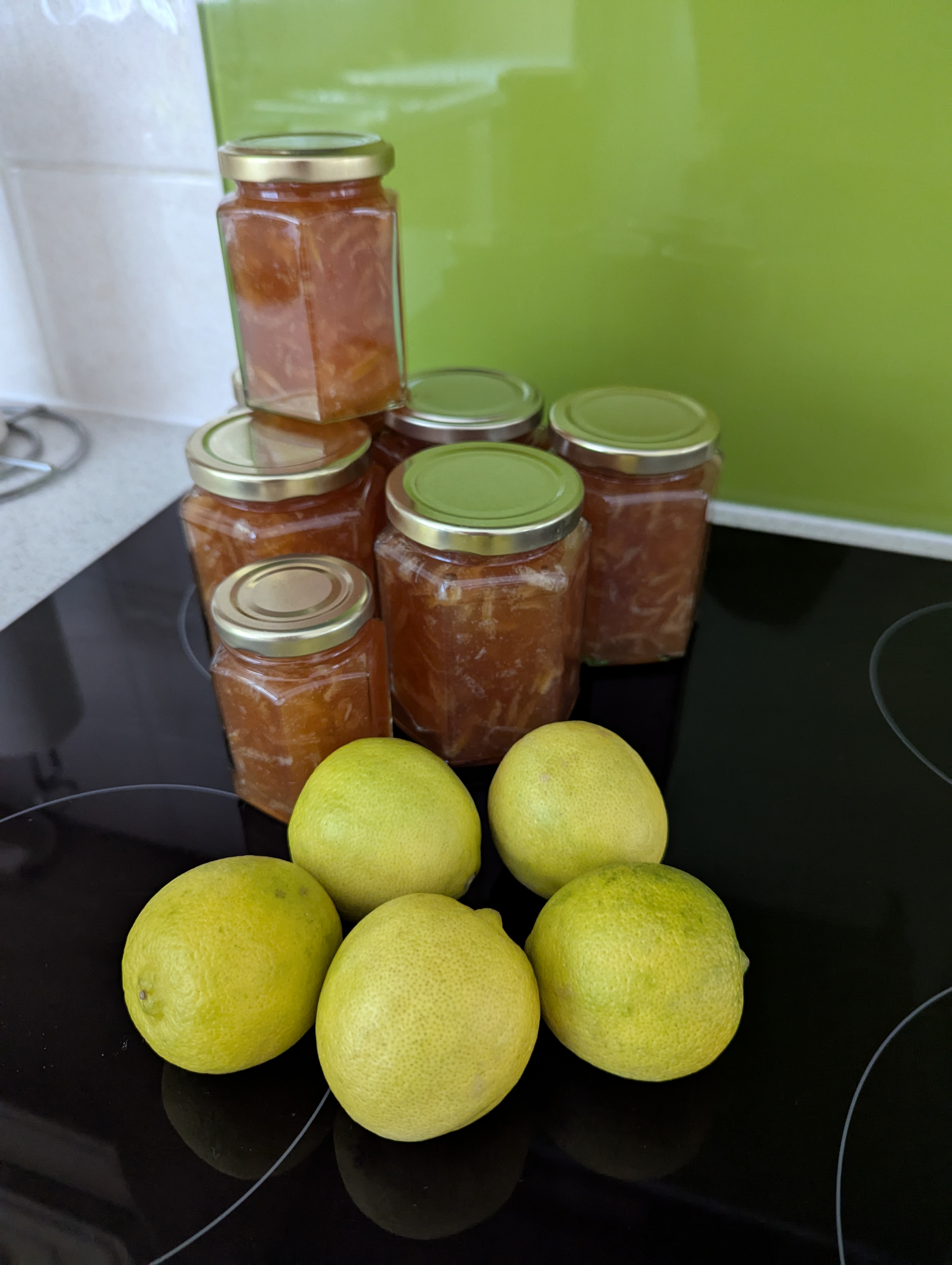
 A Lime is a thing of beauty, and as we buy them when they are lime green they are picture perfect.  Just by coincidence when we were walking past a gallery in Bath today, there in the window was a beautiful oil painting extolling the beauty of limes.


Even in our kitchen I have chosen lime green as an accent colour.  However I have known for some time that lime green limes are under ripe limes and once picked do not ripen. If left to mature on the tree they turn yellow, and as they ripen they get juicier and loose that extreme acidity.  When they are unripe and green a set marmalade requires the maker to reduce its acidity by adding bicarbonate of soda.  

Therefore when I saw a small box of limes being sold for 20p, yes about 1.5p each being sold off when I went up to Wells Fruit and Veg last week up at the Rocky Mountain Nursery, I knew one of the boxes had my name written on it.  


Even though I knew the acidity would be reduced, I still wasn't sure by how much, and thought about what I would add to the marmalade.  I have sometimes added extra 'botanicals' to lime marmalade such as cardamom and have tried juniper too, all of which taste wonderful. Over on my other blog, if you search on Lime, you will get an idea of some of those variations using limes.

This time I used cooking apples whole after removing just the stalk and flower ends.  The fruit was pressure cooked which really helps to soften the lime peel, which I then chop up after they are soften and passed all the remaining fruit through a fine sieve.  I wanted a fruity nicely set marmalade quite different to the jelly like Rose's Lime Marmalade. 

The set was perfect and this mornings breakfast proved that once again limes really do made a delicious marmalade. I'll be posting the recipe on  my other blog: Mrs Mace Preserves. 

Thursday, 5 December 2024

Quince preserves and memories

 A few weeks ago some choice Quinces arrived at my favourite Wells Fruit and Veg stall up on the Mendips. The display was small but with perfect large fruit, and I was fortunate to visit on a day when they had them. After paying, I carefully laid my two large fruit on the top of my full basket so as to bring them home in pristine condition.  With their sensuous shape and colour and still partly covered with their fur, they were laid in pride of place in the centre of the dining table and much admired over a couple of weeks or so. 

If you have had quinces before,  you learn to observe them for the moment of maturity to arrive.  Having cooked with them before you also know just how hard the fruit are and just how long they take to cook.  I was not in the right frame of mind to go on and be inspired to make up a dish to do them justice. Not wanting them to be wasted I decided to cook them and freeze the fruit and the decision on what to do with them pushed further down the line.

On my chopping board I simply cut the washed fruit, into segments, removed the central part where there tends to be the larger grittier parts, and place the unpeeled fruit chunks in a stainless steel dish with a little lemon juice and just a little water.  This I put onto the trivet in the pressure cooker with a little water in the bottom  and gave them about eight minutes.  In the cooking period the fruit had turned from its creamy colour to a beautiful translucent muted deep peachy colour. A knife test said fine, and when cooled the whole dish covered went into the freezer.

I needed the space and out from the freezer came the cooked fruit a couple of days ago to defrost gently in the fridge, with its skin so soft it would have been pointless removing it. Quince Cheese is all that I felt like making.  For once I didn't feel inspired to make anything with flavourings or spices, but with the finest shavings of a Sicilian lemon rind and its juice, with sugar in the ratio of 450g sugar to 600ml pureed fruit, as per Marguerite Patten. The fruit was pureed down with the stick blender, and then the melange patiently stirred until a thick consistency was achieved. 


In amongst my stash of empties, I found some little jars where the whole cheese will slide out onto the plate in just perfect of portions to be sliced and used with cheese.


I can't remember when I had my first taste of quince or when I first saw my first quince tree, but its existence must have seeded itself perhaps through poetry or through reading historical novels.  My eye is drawn to them in old tapestries, Japanese art and Botanical drawings and  I love the beauty of the trees as well as the  flowering quince shrubs, which is a totally different type of plant;

In gardens I seem to be able to spot them and admire them at any time of the year, however when hanging with golden fruit they are easy to spot. I remember the beautiful trees at Kelmscott Manor during a delightful visit with my friends from Kenilworth WI. At Kenilworth Castle there were some young trees planted on the bank at the approach to the formal gardens which I used to admire almost weekly.

My fried Penny (RIP) would bring me some lovely fruit from her garden, and I cannot pass a quince but remember her.

Friends Bearing Fruit 2014

Quince Prepared for the Freezer November 2015


Wednesday, 4 September 2024

Celebrating the Fig

 What can be finer than a perfectly ripe fig?  I've loved figs since I was little, so I am bound to be drawn to them. It is the time of year that brings ripened figs from across the continent and sea, and I certainly enjoyed the two trays of Turkish figs from Wells Fruit and Veg up at Rocky Mountain Nursery bought last Thursday.  At £4.00 a tray with more than 1.5Kg of fruit in each one, it was just the moment to feast and to make preserves for the winter. 

Fig and Orange Preserve infused with bay

I made some standard fig conserve, using the zest of two oranges and their juice, with just half their weight in sugar, meaning 500g sugar for 1Kg prepared fruit, plus three bay leaves. I didn't add any extra spice, this time.  If you follow this link, it will lead you to various Fig preserves I set out over several years over on my other blog.

For my second lot of Fig Preserves, I wanted to make something a little different.  Inspiration came flooding in.  As I was preparing the figs, my mind wandered over to the holiday we had near Dubrovnik and the dried figs I had bought straight from the grower at a small market for locals. Then memories from our holiday to Sicily ten years ago got me inspired. Though since it was spring, there were no fresh figs, enjoying sweet meats made with dried figs and  pine nuts and other delicacies as well as our visit to the famous Marsala wineries and our tastings at the Cantine Florio. It is no wonder therefore that when I was leafing through 'Mes Confitures' by Christine Ferber and coming across her recipe for Fig and Gewürztraminer with Pine Nuts, I thought why not create a preserve to celebrate Sicily!

Again on Sicily we visited a farm on the slopes of Mount Etna and enjoyed one of those lunches for ever remembered, with all produce from the farm, followed by a walk amongst their lemon orchards and an invitation to pick just two lemons each.  Instead of orange I used the finely zested aromatic skin and juice of two lemons.

Fig, Marsala and Pine Nut Preserve. The detailed recipe is on my other blog: 

Fig, Marsala and Pine Nut Preserve - Celebrating the Fig and Sicily


This will be the perfect filling for tarts or flans in the Italian or Sicilian style, with a covering of a Ricciarelli.

Thursday, 2 September 2021

Cobnut and Plum Tart by Dan Lepard

 I had slow roasted some plums yesterday, and was wracking my brains as to what to have for my Thursday treat.  Leafing through Short and Sweet, I came across just the thing: Cobnut and Plum Tart. The recipe is also available on line if you search for it.


Once more a very versatile recipe and technique which in essence is very similar to a crumble topped galette.  I used hazelnuts, and with the roasted plums which helps to concentrate the flavour.  I used 300g of the baked Victoria Plums.  Having eaten it I feel that a little golden demerara added to the topping and maybe some spice to the plums would be an improvement.  


Mr S liked it as it is. He asked if I was getting an extra-sweet tooth!

Sally arrived yesterday with a basket of plums from her garden.  As I have to return the basket tomorrow, the tart will still be lovely and fresh, and I hope that she and Peter will enjoy a couple of slices.  I've already made a few jars of Plum and Red Onion Chutney It will take three months or so to mature and again Sally and Peter are frequent recipients of a jar of my various Chutneys.

Wednesday, 20 January 2021

Marmalade wrapped up

There is something quite enchanting about fruit beautifully presented.   Ordinarily Waitrose sells the oranges in Kg boxes, but I was attracted by the wrappers adorning the fruit, beautifully packed, in open cardboard boxes, depicting The Ave Maria Organic Orange Farm close to Seville. Don't they look pretty used up as a wrapping for the jars before they are stored away?

These organic Seville Oranges were fresh, bright and in perfect condition.  The wrapped ones had slight marks, but it just proves that they are grown on trees and not made by some magic plastic fairy.


Fruit tissue wrappings for transport are not a novelty.  The New Gastronome has an article by Lisa Schultz on citrus fruit wrappers which is interesting.  I was transported to the foothills of Mount Etna, when we  walked through the organic citrus groves, after a delicious lunch cooked for us on the farm, 


And are those oranges on the kitchen tiles?  Maybe.  I have been making marmalade each year for years.  A note in my old cook book for 1977 shows I had made 48lbs that year, and that the oranges cost 16p per pound, and the sugar om 1979 29p per kilo.  In 1980 the oranges were 24p per pound.

Sunday, 23 August 2020

Lemon Project Box

 I'm very lucky to be able to pop up to Wells Fruit and Veg to pick up top quality green grocery items.  Recently my friend Maggie has been phoning me when she is up there at the stall, and suggesting 'project boxes' that we can share.  I had mentioned lemons but Maggie already had many left over from a previous purchase in her freezer.

Mr S needed a change, and was showing signs of cabin fever, so I persuaded him to accompany me up to Rocky Mountain, on Thursday.  Whilst I looked around the lovely fruit and vegetables and made my purchases, he went off to explore the nearby disused railway, afterwards we went for a walk around Rocky Mountain Plant Nursery.

Amongst this and that I picked up a box of lemons. These were smaller less than perfect lemons from South Africa.  When I say less than perfect, I mean they were not the uniform glossy ready for the market Class I fruit, but at £2 a box., it would have been wrong not to get one, and use it as an opportunity to try all sorts of preserves.  I had wanted to try making my own salt preserved lemons, which I use so much in my tagines, roasts etc...


A trial of making home made Lemon Cordial turned out so successful that tomorrow I shall be making more...

I shall be using this to add to the second ferment of the water Kefir.  

In dealing with so many lemons, I realised that my zester which I think I have had forever, is quite past it.  Tomorrow I am off  to see if either of the two hardware stores can come up with the goods.  If I draw a blank, it will be on line shopping, but I am giving the local shops a chance....

Another Saturday Project was turning my surplus garden grown cucumbers into dill pickles, again a first for me. The prepared pieces had been resting overnight, having been salted, and were ready to be packed into jars, when my friend Jayne, a friend from years ago called me...she of the pickled gherkin loving brigade.  I hope there are some left for when we are welcoming house guests once more.

The cordial has given me the inspiration to try making my own limoncello. I shall just have to imagine the lovely drinks we enjoyed on our holidays in Sorrento.

 This evening I shall be sitting down with all my books, and the internet open, searching for recipes to use up the large bowl of lemons which remain.

Sunday, 15 March 2020

Roasted red pepper and chili sauce with a little Red Leopard

Maybe I ought to rename this Red Leopard Sauce....

Since I first made Roasted Red Pepper and Chili Sauce, I have enjoyed it so much that this weekend I worked on my third batch, having run out completely.

During moments of boredom due to staying at home poorly, and excessive rain, I was looking at the possibility of growing Goji berries. I love trying to grow unusual things, that is on hole for the moment. 

What I do have in the garden, and had yet to try in the kitchen is some of  my Pseudowintera colorata Red Leopard.  For some time I have been considering using some this shrub also kinow as Mountain horopito or New Zealand Pepper Tree.  I had read that New Zealand chefs are rediscovering their native cuisine and adding this in chic restaurants.

Apparently you can use them in the way one uses bay leaves.  Having picked a few leaves, and had a chew on a fresh one I can describe it as having a sharp hot peppery taste, with an effect not unlike schechuan pepper adding a tingling taste. 


Two leaves of Pseudowintera bruised were added at the same time as the vinegar, and after half an hour when the mixture was passed through a thin sieve, these were removed.


Four small jars of 'Red Leopard Sauce'.

Sunday, 2 February 2020

Pink Grapefruit Marmalade

This where the pressure cooker makes show time of preparing marmalade. It takes just 10 minutes of cooking at pressure, with very little steam escaping into the kitchen.  The boiling up of all the ingredients takes place in a larger stainless steel pan.  Yesterday a small batch of marmalade was added to the store cupboard.  I revisited Grapefruit and Lemon Marmalade which I wrote about in 2012 on my other blog Mrs Mace Preserves.  This time I cut up the peel into fine shreds after initial pressure cooking, and the flesh and cooked lemon was pulverised, and added together with the fresh lemon juice and sugar.


1 February 2020
Grapefruit and Lemon Marmalade

Thursday, 30 January 2020

Seville Orange Marmalade

January is when we can buy Seville Oranges.  Our Wells Wednesday market had one of our Vegetable and Fruit Stalls with boxes of the fruit.  Often I make a huge batch and also freeze the oranges for use later in the year.  This year I want to explore new marmalades and revisit some of the others such as Pink Grapefruit, Lime and fig, Lemon and cardamon with pistachios etc...


Just seven large jars this year in the cupboard, and easily marked up rather than making up printed labels. 

Friday, 8 November 2019

Sowing the seeds of a new journey

They say a seed can only grow if the soil is ready, and the conditions too, for that particular seed.  The seed too has to be viable, and if space is limited, worth growing.

I am going to stop there, as this could lead me down the garden path, which is a place I love to be.  The other place I love to be is at the start of a new adventure.  Not too daring, not one that will take many air-miles, or cause any more pollution than is necessary, but an adventure that has the potential to enrich my life.  If it is an adventure will be based on food and eating and the Kitchen, I am ready.

It will be a journey, and an adventure and Mr S is 'behind' me.  I don't think he has a choice really, and I am sure he will greatly enjoy being my 'pack carrier' and bless him: washer upper.  I have probably been in training for this journey which will be an adventure, for which different other seeds were sown, from my earliest years.

Food and eating: good food and 'moderate' eating, has since I can remember, been one of my greatest pleasures.  Buying/growing and preparing food is one too. Whether it was 'standard' fruits and vegetables grown on volcanic soils under a semi tropical sun such as bananas, pineapples, mangoes, pawpaws, lobsters, fruit bats, hedgehogs and venison, or enjoying other delicacies such as imported olives, which my father adored, or coming back to England and enjoying iced lemon buns, and the wonderful wholesome dishes at my Grandmothers, I have always been adventurous.

A few weeks ago I happened to be listening to BBC Radio 4 Food Programme on the topic of 'how to get Sour back into your life'. ( How long the Programme will remain viable in the link, I cannot guess). At the time most probably, I was making Sourdough, which is another sort of sour.  Of course we love my chutneys, some of which I post on my other blog

From the library, I am enjoying reading Mark Diacono's prose on

sour/the magical element that will transform your cooking


I had started to dip my toes in a not unfamiliar pond, and am now a regular in the making of kefir.  I had been making kefir around fifteen years ago regularly, but something went wrong with it, and not having access then as we do now, didn't understand properly the needs of the kefir grains, which after some time, just died!  This time I am enjoying my kefir in all sorts of ways.

I happened to have ordered Fermentation by Asa Simonsson at the same time.  Reading up and planning is part of the excitement before a new journey, which I also enjoy. 


When I popped round to my special salad leaf supplier: Frances, and we were talking about this and that, she invited me to taste the Beetroot Kvass she has recently made.  I love beetroot, I love salty...she poured a little in a small bottle for me take home. 

I had been hearing and wondering for some time about preserving without vinegar.  When I was about eight, I heard my grandmother talking about salting down, and bottling garden produce for the winter...but how she cooked and ate them, I haven't a clue.  I suppose this sort of preservation points back to the days before electricity.  They lived in a part of Lincolnshire where electricity only arrived in the early 60s. My parents also make a type of Achard which used many of the techniques, which I enjoy making and more importantly love to eat.

Earlier in June, on our way back from our holiday in Devon, I wanted to stop off at a plant nursery on my HPS list...White Post Nursery near Wellington.  We had a little turn there...and it was near lunch time, and on cue Mr S asked 'what are we doing for lunch'?  He had gone back to the car,  and I had just returned from having a second tour of the nursery on my own, and I took it as a hint that I had spent too long looking at plants.

I said how about trying that cafe there...just on the side of the car park.  In we went, and I was amazed at the love and  thought put into the assembly and display of a myriad of fresh produce, and the deliciousness of the lunch.  Sadly it is a little too far from home or else I would be a regular!  I knew just by seeing the bread and other baked goods that this was my sort of place.  If you are in the vicinity of The White Post Cafe, do please plan in a visit.  With a few leaflets to hand, which I was pointed towards when asking about who supplies their bread, I came away with information about The Bakery which used to be on the other side of the hard standing but had now moved a little way away to Tracebridge: Tracebridge Sourdough and Fermenteria.

Not surprisingly after we had settled down after our holiday, I looked into Tracebridge, and fancied maybe one of their patisserie courses.  As we were in thick of decorating, the thought was parked.  However after the tasting the Kvass...and being determined to beat off the winter blues and in need of an adventure, last week I checked to see if they had any Fermentation classes.  Yes there was one only a week away, and only one place left.  I am on it!


Wednesday, 24 April 2019

Achard Revisited

Now a 'new' member of the Wells WI gourmet club, for my first evening I have made some preserves for our 'Curry Evening'.  As achard tends to be unknown in this area my host was keen for me to make some.  It is ages since I last made it.  It takes a lot of preparation if you are chopping my hand, and there have been many other jams, pickles and chutneys made and eaten.Many of them posted are posted my other blog: Mrs Mace Preserves.

Having to provide a  recipe sheet for each of the members of the club, I opted for a manageable amount of Achard, and  fine tuned quantities, and developed my own spice blend.

Achard using the salting method with cider vinegar giving a twist of Somerset

The following are prepared weights and is based on a small whole cabbage and cauliflower.  Weigh the ones you have, and adjust the other ingredients accordingly.

575g hard white cabbage, chopped into julienne sized pieces
500g tight cauliflower, subdivided into tiny florets which will look good in the pickle
200g carrots cuts into fine julienne about 5cm long
150g fine french green beans, cut on the cross into fine slivers
200g shallots or pickling onions, cut through the root end so as to keep pieces together

300ml cider vinegar
50g  unrefined sea salt

4 large garlic cloves
50g crushed fresh ginger

125g cold pressed virgin rapeseed oil

Olive oil to dress the tops of the jars

Achard Spice Mix

3 level tablespoons ground turmeric, 1 tablespoon dark mustard seeds, 2 teaspoons fennel seeds, one or two small dried chillies or to taste.  Put the spices all except 1 tsp mustard seeds and put through a spice grinder...not over fine. Mix in the whole mustard seeds, and set aside until needed.


Pack the prepared onions tightly  into a kilner jar or similar, cover with all the vinegar, cover and leave steeping at room temperature overnight.


Prepare all the other vegetables, except for the ginger and garlic,  the afternoon of day 1.  Place them in a large strong plastic bag, toss in all the salt, and turn with your hand.

Squeeze down the bag, to exclude as much air as possible, and shut it tightly with a clip.

Move and turn the bag around a few times over the next two to three hours to distribute the brine.

Place the bag of vegetables and brine in the fridge overnight.

 Overnight, the vegetables in the bag 'wilt' visibly as water is removed under osmosis.

 After 24 hours, cut a corner off the bag, and drain off the fluid, squeezing the bag. Then in a colander, quickly rinse the vegetables in very hot water in batches, then squeezed them very thoroughly in clean kitchen tea towels, to dry them as much as possible.

In a large pan heat the oil , then added all the spices, ginger and garlic, and cooked these gently stirring for five minutes on a gentle heat...taking care as they should not scorch or stick to the pan.

Add the drained onions, and cooked these for a couple of minutes. Add all the vegetables and  toss and turn these in the oil, with the heat still on.  Add as much of the vinegar from the onions to give a good coasting to the vegetables.  Stir for a minute or two...that's all the cooking done!  Taste and add a little salt according to taste.  Take care, it is better to add salt at the serving stage later, when you have tasted the mature achard.

Pack the pickle very tightly into sterilized  jars, pressing layers with the back of a strong spoon or similar.  Run a spoonful of oil over the top to form a seal.  Close the lids.  As soon as the achard is cool, store the jars in the fridge.


This achard needs at least a couple of weeks to mature in the fridge, then ought to be eaten within the following six weeks.

To serve, place in a bowl, and flick through with a fork...it will look like a dressed salad.  Do not return to the jar, but keep and eat within a day once taken out of the jar.

In Mauritius this sugar free pickle is traditionally eaten as a side dish to curry and rice, and great in crunchy sourdough type rolls with cheese.

Its interesting to ponder the history or origins of the Mauritian Achard.  My father was born to French and Portuguese settlers to the Island and the family were great entertainers having the whole extended family for 'banquets' where over 50 fifty people would congregate for New Year's day lunch.  I am sure Achard would be on the table. 

My father explained that before refrigeration, and particularly when there was a glut of vegetables, it was an effective way of preparing in advance and preserving  large amounts of vegetables.  The jars or most probably large stoneware jars of pickles were also easier and safer to transport.  In the heat of tropics a cabbage or cauliflower can go to seed in just a few days, or even when picked, without refrigeration will be spoilt in less than half a day.

The pickle also adds that tang which aids digestion to plainer dishes of rice, lentils, and meat or fish curries.



Sunday, 10 February 2019

Sunshine Jam on a rainy day

When its cold and wet....making Mango, Lime and Cardamom Jam is the way forward:


The link above leads to my blog on preserving in case you would like to follow a step by step guide to making this fabulous preserve.  Just right for topping yogurt, cheese cakes or any other way you would like to.  Marie Claire, I know would have it on brioches.

Sunday, 13 January 2019

Seville Nouveau

We have all heard of Beaujolais Nouveau.......

With the first Sevilles of the season, some big juicy lemons and cane sugar I give you Seville Nouveau.  A simple Seville Marmalade:  Seville Nouveau.  If you would like all the tips, and I think this is my final version do check out Mrs Mace Preserves.


Again mastering pictures taken with phone, and uploaded straight to blog....quality not great, compared to my Canon IXUS, below, but it may just be the operator.


Friday, 4 January 2019

Mahonia Gin


Mohonia Aquifolium is a tough plant, and was here growing in the garden when we moved.  It is a large shrub growing against a stone wall...

In mid winter before the flowers appear the foliage turns a red and bronze colour.  It is soon followed by clusters of sweet scented flowers which are a magnet to early foraging bumble bees.

During the Summer, when it was heavy with its small purple fruit, Blackbirds soon followed by other fruit eaters started to harvest the crop, with branches weighed down.

Not surprisingly, after a little investigation I decided to gather a bowlful of the small fruit.

Having washed them, I put them in the freezer.


I had thought of adding them to some jam or fruit jelly, and had quite forgotten about them until the end of October.  When I realised that it was a little late to start to look for sloes, the thought of trying a little 'Mahonia Gin' came up. 

My current gin of choice, on account of quality and price is this one...here photographed with another of Lidl's best products in this household...


I added the frozen mahonia berries, with equal weight of caster sugar to a kilner jar, and then just covered them with gin.

Every few days it would come out of the cupboard, be shaken, then put back in the dark.  A couple of days before Christmas, I used the port filter to strain off the liquour....


I came across Geoff's post and having read that the berries are not poisonous, was reasonably happy in trying this just for Mr S and myself.   The verdict is that it is worth making and since there were so many berries...enough for us and the birds...a small glass each over the festive period topped up with our favourite Feverfew tonic brought back memories of summer, flowers and birds.


Sunday, 26 August 2018

Plums galore

No longer having a plum tree, it was with open arms that I gratefully received a bag full of Victoria Plums, when new friends came to visit this week.

Plums really don't last very long once they are picked, certainly if they have not been sprayed or washed in preservatives etc...so the following day, it was time to grade and wash them, and start using them up.

I made preserves, using two new original recipes:


The full and detailed recipes are on my other Blog: Mrs Mace Preserves, but clicking on the title of the pictures will lead you straight there.
.


The rest, after a handful were eaten, were slow roasted to turn them into semi-dried plums, which are now in the freezer.  

Only today I picked up an email from Jane the donor of the plums asking how to bake the plums.
Preserving the plums means having to remove some of the moisture,  As lover of plums know, they don't last long in the fruit bowl, being very juicy and prone to moulds.  

Using firm but ripe plums cut them in half , and remove the stone, and trim any little bitten bits.  Lay out the halves on baking trays covered with baking parchment.  Sprinkle gently with a little caster sugar, about two teaspoons to a medium tray of plum halves.

Bake in an oven about 140 C, or slightly lower, which will take longer...The aim if for the juice to evaporate and leave a plum that is not browned or burnt.  Until you get used to your plums, your oven, and the effect you want, just keep opening the oven and having a good peep and feel.  This also allows the moisture to escape.  It may take a couple of hours or longer.  There are many guidelines on the internet.  I end up freezing these small morsels in layers interleaved with baking parchment to keep them separate, and like to leave them soft and  looking like they do above.  

During winter months  these come out to be incorporated into bakes or to add to desserts.  The last time I had a bagful given I devised The Kenilworth Bun.


Wednesday, 18 April 2018

Lime...sharp and citrussy.

Its greening up in the garden.  Of course the ever green Holm oak just over the wall is a constant backdrop.  Even in the winter the sun shines off  its dark green shiny leaves and the contrasting silver of the back of leaves can shimmer in gentle breezes.  Within the garden I like form and strange structures, leaf patterns, with different greens, purples, splashes and splodges of creams and whites....one of my favourite plants however humble it may be is  Alchemilla Mollis.  I also have Alchemilla conjucta which is more silvery with hairy leaves.  I have yet to find Alchemilla erythropoda but will be on the look out for these at the local rare breed plant fairs. I would have loved to see the collection at the Botanic Gardens when we visited Cambridge  a couple of years ago, but it was closed due to the high winds.

"One of the things that make Alchemilla so interesting to plant scientists is that many are able to produce seed without the need for fertilisation of the flowers; this is known as apomixis. There are very few plants that are like this. It means that the seeds are genetically identical to the parent plant. This is useful on a practical level for gardeners because any seedlings that arise in the garden will be exactly the same as the parent." Source Cambridge University Botanic Garden Web Page.


Green is probably my favourite colour...and lime seems to work beautifully at this time of year.

Another of my passions and 'pass temps' is preserving and even have a separate blog where I publish some of my recipes, preserves, and trials.

Mr S likes straight forward preserves, and amongst the pots at breakfast rarely reaches for the lime marmalade.  It is one of my indulgences.  Since having Roses Lime Marmalade which must have been specially imported to Mauritius for all the expats like my Mum, as a child, I have been rather partial to lime marmalade.  This batch included lime and juniper, no gin, and Lime cardamom and ginger.  I was quite surprised Mr S he said: "What no 'just lime' for me?"


Back in 2012 when we had a break in Sherborne,  one of my 'souvenirs' was a jar of lime and fig jam/marmalade from a craft preserver at the Farmer's Market.  It was sublime  two of my favourite things in one pot!

Over on my Facebook page a friend mentioned that she rarely sees home made lime marmalade. This may be because it is quite tricky to get a set, and not just that the limes take a very long time to cook until the peel is soft.  Here again the pressure cooker reduced the time considerably.  

Indeed I used to think the problem of getting a set was very strange, I have found out that this is because the fruit is too acid, and the acid inhibits the pectin.  Dan Lepard one of my go to authors admits to this problem but there is a solution: adding a little bicarbonate of soda.  As limes ripen the acidity falls.  

Many of the limes we have access to in the UK are picked really underipe which also accounts for their not yielding much juice.  The box I bought last week must have been picked almost at the perfect point.  They were a pale yellow with a hint of lime green, and as juicy as a juiciest lemon, with a thin skin.  They have no pips at all so they are most probably Persian Limes: Citrus latifolia.  These types of limes are parthenocarpic which mean the fruit grow without fertilisation. 

From flowers that can set seed without fertilisation, to fruit that can set without being fertilized and having no seeds...and I thought about just writing about why I think there is not much home made or craft lime marmalade!  One friend's comment opens up such avenues for exploration and discovery.  I love to have comments so thank you for them. 

Saturday, 31 March 2018

Earliest Strawberry Jam

We are both self confessed preserve lovers.  Maybe we have different tastes...he loves Strawberry and Blackcurrant the most, I like all others....I particularly love chutneys and pickles, and have even set up another blog to talk about them.  

Mr S has had to revert to shop bought strawberry and blackcurrant preserves and has admitted that even my least successful batches are way better than the best we have bought.  When I walked into our local supermarket yesterday I was taken by a 1Kg 'crate' of strawberries.  They were the large imported ones but very fresh and in perfect condition.  Last year I made some successful batches using locally grown strawberries...but needs must.


Just in case you want to read what in on the Little Heart that my friend Jayne gave me it is

Happiness is time spent in the Kitchen...

Of course I also love to read, garden, spend time with friends, gallivant etc etc...

Saturday, 20 January 2018

Doubly early Rhubarb Jam


Early Rhubarb from the Yorkshire Triangle get made up into Doubly Early Rhubarb Jam this morning

Wednesday, 2 August 2017

Beetroot Chutney using local Cider Vinegar

Back in 2014 I posted my recipe for Beetroot Chutney on this blog rather than my other blog Mrs Mace Preserves.  Once again there are lovely beetroots in the market. I trailed through my books and on line for another recipe.  I had got rather excited and bought a little too many bunches.  I upsized the quantities to match 1.5Kg prepared beetroot.  I think 1 Kg gives about the right number of jars for home consumption.  Friday evening when Mr S was out playing trains...it was time to get out the chopping knives and boards.

I ended using my own recipe....dear reader!  However for the first time since moving, I used a locally bought and made cider vinegar.  This latest purchase from Earthfare Glastonbury comes from a small holding within Somerset: Honey Pot Farm.  The vinegar is unfiltered and unpasturised and has a lovely golden colour, it tastes good with great cider and appley flavours...we have a little tipple diluted in water for medicinal purposes each day...but the greater quantity goes into my preserves.  I wonder whether we shall come across a cider vinegar tasting or competition now we are in Somerset.  If you know of any, please do link them into this post.

Each time I make this chutney, I may slightly vary the blend of spices.  Instead of dried ginger I used some fresh ginger very finely chopped.


It was red onions....


and having first cooked the beetroot for 20 minutes in the pressure cooker, they were very easy to chop up.


Some time later, with many jars washed and sterilised it was time for potting them up.


Not bad for an evening's work: output 6 large and 9 medium jars of chutney...lots of lovely chutney stashed away, ready to enhance many a supper or lunch: great with goat's cheese, cheese mac, cold meats etc....


My hero returned in time to rescue me by helping;  clearing and washing up with beetroot deserves a medal!

Sunday, 22 January 2017

Visiting New Garden Nursery and Making Mango Chutney

On Thursday I went for the first time this year to my new knitting group...and I was really pleased when Maggie asked if I would like to go with her on  to the Rocky Mountain Nursery which is about three miles out of Wells.  I had looked it up and had penciled in a visit for some time soon!  I thoroughly enjoyed, despite the piercing cold, helping Maggie with her choices and purchases, then helping to unload and split and spread out the bags of compost.  Only two keen gardeners could get the work done this fast in failing light.  I brought back a little pot of crocuses and a small bottle of house plant feed...

Maggie had needed to pick up another ten bags of ericaceous compost for her newly built raised bed, and she also wanted to see what the new green grocery stall which has set up at the Rocky Mountain Nursery every Thursday was like.  We are both newcomers to the area, and this market stall holder used to be in Wells and had a good reputation.

They had some good quality produce and for £2.50 you could get a whole box of mangoes...about 15 medium sized fruit.  Only last week, Mr M was lamenting the fact that  we had used up the last of stashed jars of Mango Chutney.  I was even calculating how to get the fruit on my bicycle and then back home!  Maggie gave me a lift right up to my bike!  We are visiting again next week as Maggie has put in an order for a full crate of Seville Oranges.  I can see that both the businesses will benefit from this association, people wanting fruit and veg will visit the nursery and visa versa!

I now need to get on and design and print the labels...then get these beauties stashed and maturing in a cool dark place! It was interesting making two types of Mango Chutney at the same time and seeing the effect of steeping the fruit in sugar