Since the restrictions, our gardening club have been making a great effort to engage with all members. One of things we have done is to produce a monthly newletter. Sally Gregson plans it, and our Secretary SueThorne sends this out to all members. We have three members who receive a printed copy.
This has given members the opportunity to write a short piece, which is supplemented with pictures. So far I have written three articles, and I thought I would post it here. Because we want to limit the length, not all the pictures I am uploading here were on the newsletter.
Yes, you can ‘grow Hens and Chicks’: I gave this talk to the
local school gardening club, and brownie and cubs’ groups in Wroughton, and
took a pot of a single sempervivum for each of the children, who were invited
to enter a competition the following year. At the Gardening Club, where I was
assistant show secretary, we completely underestimated the number of entries we
would have at our Autumn Show, as children along with parents queued up with
exhibits. We had great feedback as to
how the growing of these little plants, with the swaps amongst pupils and
visits to garden nurseries had stimulated the interest in gardening generally,
with grandparents too joining in.

With their colourful rosettes of leaves, there are many sempervivums
cultivars to choose from. They range
from bright yellow though to grey and purple.
Some have colour variations, or dark tips, with some forms such as S.
arachnoideum having hairs which elongate to form a ‘cobweb’ over the surface.
Sempervivums grow naturally in mountainous regions where growing conditions can be very harsh, ranging from high temperatures to freezing, but have good drainage, and are a perfect choice for green roofs or on sheds or bin stores.
 |
| Sempervivum growing on a wall..picture not part of the origianl article |
They can survive in very little soil, but they do have an
extensive root system what reaches down between rocks to give them anchorage
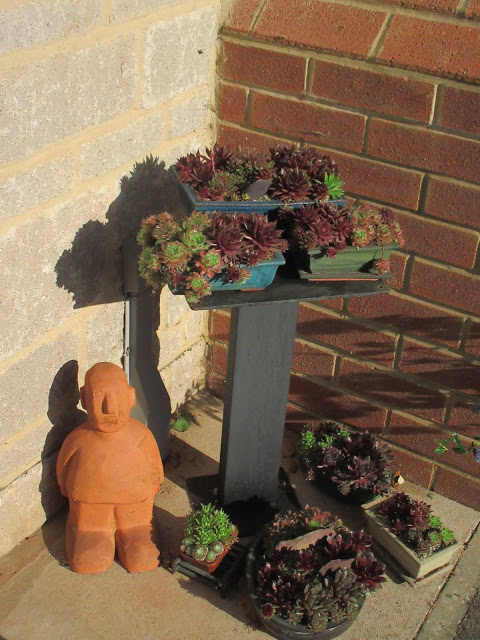
and reach water and nutrients, where they grow in the wild. Mine are potted up in recycled bonsai trays.
Sempervivums are also very useful as ground cover on an open sunny well drained position, maybe amongst other drought tolerant plants or mixed planting of succulents, and amongst other alpines.

Sempervivums are normally grown for their leaves rather than their flowers.

They have cycles of growth, which varies over the year. The best time to buy 'houseleeks' is during the late spring, summer and early autumn. Plants are then growing actively and rapidly become established after repotting. They are practically dormant during the winter, but as temperatures rise they start to grow again. You can start out with a few rosettes from friends, or buy two or three pots from a nursery, and tease them into single units and plant up a number of pots. You could almost solve your Christmas Present list a few months in advance.
During the first and
maybe the second year the plants produce offsets, and then they may flower. The
flowers are not insignificant, and are an extra bonus. As they are monocarpic, once they flower they
die. The offsets are useful to establish
new colonies or rejuvenate new pots.
I repot my sempervivums when the pots are overfilled and after flowering. Once watered in, the small rosettes manage perfectly outside in all weathers, with just the occasional water, should we have more than a few weeks without rain, in their early stages. A good well drained compost with about a quarter by volume of added grit and a slow release fertilizer for potted displays.
The rosettes easily survive if their roots are damaged, and grow
new roots from the base of the rosette.
Look out for vine weevil, but everything is not lost: just clear some of
the lower leaves to reveal a little of the stem, and stick these in some fresh
well drained gritty soil.
Copyright Noelle Mace 2020.....
I used to have several individually named varieties, and looking back on this blog, (sorted for you to view all the sempervivum entries), my earliest entry regarding sempervivums was March 2009, when I had bought Sempervivum Brown Owl. I don't have this one anymore, probably given to a 'Brown Owl'!
Oddity also seems to have 'disappeared' too.

These days my pans are all mixed up, but having written this article, I can feel a change may be on the way next year, with a few specials added.
AlthoughI my fascination with the shape of the rosettes goes back very far indeed, I ought to give due thanks to Howard and Sally Wills's Book and pictures.

I must have bought these either at a show or a talk, many years ago. Fernwood Nursery holding the National Collection is in Devon, is the go to place if you wish to order excellent plants.


