Showing posts with label Recipe. Show all posts

Friday, 10 January 2025

The Perfect Cobb Loaf Using 'Rock Star' flour

I've been a member of Bake with Jack's Homebaker's Club for some time now.  You would think I had nailed everything around breadmaking over the decades I have been baking, but still there is the element of learning, testing and tasting bread that enriches my life.

Sourdough takes three day for me, but when there is need for a loaf in say five or six hours, and you want just a good loaf, baking a Cobb Loaf fits the bill perfectly.  This is the second or perhaps the third time I have used YQ Wholegrain from Matthews Cotswold Flour, and this is definitely the 'Rock Star of Loaves' to have fresh and also makes excellent toast. 


 I tweaked Jack's recipe but followed his technique.

7g Fast Action Yeast

350g Room Temperature Water

375g Matthews Cotswold YQ wholewheat stoneground flour

150g Matthews Churchill White 

8g salt

1 dessert spoonful malted barley syrup

20g rapeseed oil

Following kneading of around ten minutes, two rises of 60 minutes, with a degas and made back into a ball for the second rise,  and a final rise of about an hour is about right for the lowish temperatures in the house this winter. 

The YQ flour is strong enough to make for good shapes along with the Churchill Bread Flour, and the flavour is excellent.

 "Matthews Stoneground YQ Wholegrain is a dark wholemeal flour, with a beautiful rich nutty taste. Perfect for sourdough breads, cakes, pastries and all-purpose baking. YQ ‘Yield & Quality’ is the rockstar of wheat populations. It is produced from a diverse, resilient populations of wheats. Use this flour in wholemeal recipes for it’s unique taste profile. These genetically diverse wheats are grown using a low input farming model which supports the regeneration of the soil, minimises use of chemicals and increases biodiversity. "

Sunday, 5 January 2025

12th Night - Why not start a tradition which involves cake as they do in Venice?

 Although I am lucky enough to have a fair  number of recipe books, I can't help myself but want to see what inspiration other books may hold. When I read that Jane Swayne a local chocolatier gains inspiration for some of her flavour pairings from The Flavour Thesaurus, I ordered the more flavours version by Niki Segnit, and being reminded that the book was due back as someone else had requested it, I decided to have a quick dip into it on 11th Night.

In the Pine nut section Niki describes a cake she and her husband enjoyed in Venice called Pinza which is traditionally eaten on twelfth night, and probably more often too.   Although there is no recipe for Pinza di Pane given there I soon found a version given on Nigella's site.  Sadly the library system does not feature Cinnamon and Spice by Emiko Davies whose recipe it is and who was a guest writer on the site.

Pinza di Pane

There was enough time yesterday evening to make this equivalent to a bread pudding: after all what is not to like about a bread pudding? Apparently there are many versions of this some using polenta or other grains.  As I was making this I was reminded of the Polenta Shortcake I made back in 2020.

Most of my cake tins have loose bottoms, except for a couple of 7 inch sandwich pans.  As I had halved the recipe and substituted many things, it fitted perfectly.

As I had just 120 grams of stale seeded sourdough left in the bin, I selected the other ingredients around this.  For the techniques I followed Emiko Davies, including the baking times, which as it was wet turned out to be just right for the smaller amounts.  To help ease the cake out I base lined the tin with baking parchment.

Starting off with120g Stale Bread soaked in 230ml milk, whilst the 75g of sultanas were soaking in some of my prized Mauritian Vanilla Rhum, I prepared all the other ingredients halving the amounts in the recipe.  Oh no I didn't have an orange so I got out some lovely candied orange peel chopped it fine and added that.  The little dried figs were a beautiful site cut into think slices. Although not given in the recipe I sprinkled a few pine nuts over the top just before they went into the oven.

Today after we have cleared the house of decorations and I have undone the wreath and stowed away the willow base in the shed for another year, what nicer thing will it be to sit down and enjoy a slice of Pinza de Pane and a little glass of Marsala from Sicily, as a fitting end to 12th Night.


Monday, 31 July 2023

Home made Pici pasta with salmon and fennel soffritto

 If it had been dry I would have been out in the garden messing around, and as I did not wish to sit and read, it was in the kitchen that I did some of my playing around.  After the short apres lunch rest, I flicked round the copy of Waitrose Food I picked up when I popped into the store on Saturday, when for no reason except I didn't have any, picked up a bag of their Super Fine 00 Pasta flour. 

Chris Leach's recipe for Pici with clams & fennel soffritto sounded interesting.  The pasta is made with flour, water and olive oil.  I had thought hand made pasta needed egg, not that I am avoiding eggs, but it was intriguing. It is ages since I made fresh pasta , and not long after this, the pasta machine went to a charity shop.  It was the washing of the intricate machine that got to me.  Gnocchi has always been made from time to time too. 


I made just 100g worth of flour, but used some of the mashed up pumpkin which I had roasted yesterday plus a little warm water.  Next time I would warm up the pumpkin and puree it and use that to mix in with the flour and olive oil.


Since I already had a fennel bulb, and wine open, I made up the Soffritto as per the recipe but with no Pernod used dry Marsala, and with no clams used up large flakes of cooked fresh salmon, again a left over having been a way of cooking the 'trimmings' after I had portioned up two sides of Salmon fillets bought on Morrisons' 20% off Fish Friday. 

And added two small courgettes ready in the garden and some French Tarragon.  I've since watched how to make the pasta which seems easier than the technique shown in the magazine. since this was meant to be a Pumpkin Pici I topped the dish with roasted pumpkin seeds. I read an interesting article in Grape Tree Magazine about the benefits of Pumpkin seeds, and that roasting improves the antioxidant levels.  

It was very tasty...a nice supper on a damp evening.


Since what was to be my glass of wine left over from our weekend bottle went into the soffritto, I had a little glass of dry Marsala to make it a delicious dinner.


Saturday, 17 December 2022

My Best Flapjacks

 Several people recently have asked for the recipe for my flapjacks.  It is difficult to give you the ultimate or exact recipe as each time I vary it a little depending on the occasion or the time of the year. I started off with Mary Berry's Fast Flapjack recipe several years ago when I bought 'Baking Bible', and over the years have adjusted it adding on the main more oats and several handfuls of 'other things'. (I shall take more pictures next time I made and update this post with them)

You can look up the tips and understand what can go wrong, and on line the recipes have different ratios compared to the book.

These flapjacks only two pieces remaining, were made for Mr S to take to his session playing trains on some large layout in Dorset, he even took flapjacks to Pete Waterman when he 'played' with him on his layout several years ago when we lived in the Midlands.  They are similar to the ones I sent for Julie and Colin to enjoy with their tea after the lovely delivery of Apple Juices, a couple of days ago. 

These had diced ginger, cranberries and pumpkin seeds.  I'm just having one piece with half an apple for my afternoon tea as I write this.

I use goat's butter which behaves a little differently from cow's butter.  Sometimes I use half rolled oats which are the larger ones and half porridge oats but have also successfully used all porridge oats or all rolled oats, when these were all that I had.

Ingredients

255g Butter

200g demerara sugar I use Billington's

100g Tate & Lyle's golden syrup

350g Porridge oats/rolled oats

In addition I have used all the following, sometimes altogether 

Grated Orange Peel from one orange. Eat the orange for your breakfast!

*Five or size knobs of preserved ginger in syrup, chopped small

A handful of pumpkin seeds/sesame seeds or poppy seeds /chopped pecan nuts/walnuts/pistachios(just one handful either one of these or a mixture, more than two types is too much of a hotch potch)

A handful of dried cranberries/chopped dried apricots/raisins or sultanas/crystallized orange peel(one handful of either one or a combination)

I use an oblong 12 x 8 x 2 inch loose bottomed baking tin by Silverwood, which is ALWAYS lined with baking parchment.

I have one of those useful scales with a glass top, which can be zeroed as each ingredient is added. 

Weight the butter, sugar and golden syrup into a largish pan.  Heat gently till the butter is just melted, and remove from the heat. Stir whilst melting to prevent sticking to the base of the pan.

Use the lined baking tin to weigh the oats in and add to this your extra ingredients.

Tip the dried ingredients into the pan, and mix well, then pour everything back into the lined tin.  Level well with the spatula you used to mix everything.  This means less washing up!

I bake at 140C in a fan oven.  Bake for 35 minutes or until light golden.

Cool in the tin for a few minutes then carefully transfer to a cooling rack.  If they bend a little wait a little longer and they will firm up. For cutting place on a large level board or surface and cut using as long a bladed knife as you have.  When I want to freeze the flapjacks I just parallel lines to the short side of the tin, and freeze lengths, and cut them into individual pieces when they are thawed.

I remember the Tate and Lyle Tins from my earliest years, and very much enjoy looking out for new limited edition tins.  


* In the background is my jar of preserved ginger in syrup which sits on my worktop all the time.  I buy the large bags of crystalised ginger from our Grape Tree Shop in Town, fill the jar add a couple of tablespoon of golden syrup and then top up with boiling water.  It takes a day or so for the ginger to absorb, swell and for all intents and purposes is the same as the ginger in syrup.  Since I reuse the same pretty and sentimental jar each time, no glass needs recycling, and I have two types of ginger on hand.

I've just visited the Tate & Lyle webpage and found an array of delicious sounding flapjack recipes!!!!!


Friday, 2 September 2022

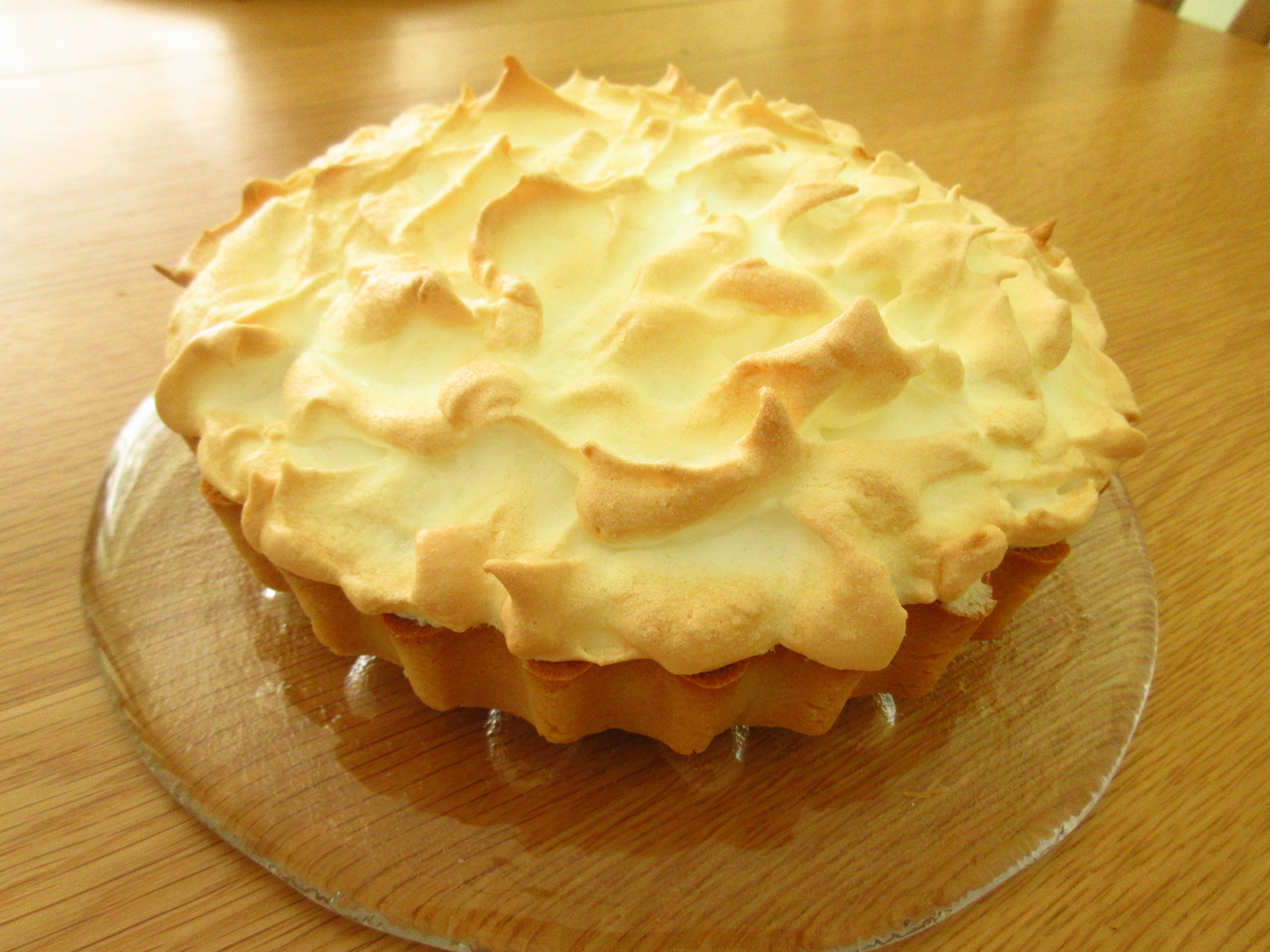
Lemon Meringue Pie

 I tend to make Lemon Meringue Pie when my sister visits, so it is some time since I last made one.  Maybe I have made it just the once in between, but it took me ages to psych myself up to make another one, and realised that it was not having the exact details of some of the small things to hand.  

One thing I dithered over was the size of the tin to use, for my future reference it is the smaller of the deep fluted Silverwood flan tins the one measuring about 20cm. 


Remembering just how good Clive Mellum's pastry was, I opted for this again but could not recall how much as required, so went ahead and made 300g of flour up, but I have pastry to spare, and using 200g flour, 100g butter, 50g caster sugar, and 25g beaten egg, will be sufficient for this tin size. I did think that using plain organic flour would be good, but the pastry was far too short and difficult to roll without it breaking up.  Clive's recipe is partly to demonstrate how technique affects how flour behaves, and all his recipes including the pastry one does use strong flour, and therefore when I made this again, it will have to be with strong white flour.


My second quandary was regarding  the lemon filling and meringue on the top.  I couldn't remember which book I took it from, and checked various ones, but lemon meringue pie is not in many of the more up to date books I have, but I did find a good one in Leiths Baking Bible, p 116.  The curd was easy to make and the meringue included an unusual addition of a cooked cornflour paste.

The proof in is in the pudding, and between our friends Colin and Julie, we made a very good indent with a piece small enough to have for a late snack for Mr S. The meringue held very well for the day and did not weep. 


Sunday, 14 August 2022

Chilli, cheese and Rosemary Polenta with tomato sauce

 Mandy a friend from Kenilworth and I frequently share our 'findings' on a number of topics, or are inspired by our blogging posts or Facebook musings.  Mandy and her husband have a superb allotment and love to garden to produce vegetables, fruit and herbs, and at the moment I would say that is her special super power.  She has others of course...

She shared her picture of  Chilli, cheese and Rosemary Polenta with tomato sauce which she had made some time ago, and I just wanted to do a little cooking or rather preparation in advance for the evening meal.  I found the recipe on line, but it is also in River Cottage Veg Everyday by Hugh Fearnley-Whittingstall. I just happen to have that as well as Much More Veg out from the library. Over these hot days when there is little strenuous work possible after 11 am, I have been going through these and adding little tabs on dishes I would like to cook. 


Dinner was enjoyed outside late in the shade: homegrown veggies and the chilli cheese and Rosemary Polenta wrapped in thin pancetta slices.  


I made the Polenta and cooled it in some oblong dishes, so that I could get some good chunky chip shaped pieces.  Some I wrapped in some thinly sliced pancetta, and the others left without. Except for the ones I was cooking that day, I have frozen them, to pull out and defrost and have for a 'ready made meal',  I open freeze them then remove them and add them to a  box in the freezer. 

Thursday, 4 August 2022

Maize pudding better remembered as Gateau maïs or Poudine maïs

 I've been considering trying my hand at revisiting this well loved snack/pudding/ desert which I loved when I was a child.  I don't think my English Mum made this, but our cook made this for Dad and I went we were at home on our own.  Often it was offered at tea time on visits to old 'aunties' together with a cup of Vanilla Tea for adults or Coca-Cola or Fanta for the kids. My choice would have been home made lemonade with Citron de Rodrigues, or 'Sirop Canne' which you could get as a dark sticky liquid straight from the sugar estates during the sugar pressing season. Diluted with ice cold water and a slice a citron,  Sirop Cannes has to be one of the best non alcoholic drinks! That has given me an idea to try to create this drink at home.

 I had been thinking about why a 'boiled' pudding or cake.  Very few people had electric ovens, or even refrigerators,  and cakes had to be bought from a Patisserie, but this could be made at home, even over a 'charcoal brasier' or feu de bois  in the outside kitchens of the old Mauritian colonial houses,  and was affordable to even modest income families.  There were umpteen versions, none tasting the same,  as each cook added their own twist depending on what was available.  As a 'Gourmet Gourmande' which was one of my father's pet names for me, I never passed over the opportunity of tasting home made offerings.

Of course I searched the internet for recipes and for the origins. I remembered grated coconut in the pudding rather than on top some of the time, which would of course mostly been from the grated flesh of a fresh mature coconut, often straight from the garden,.  Maize grits were locally produced and I do remember my old friend telling me how her sister used to whine during the war, when Mauritius suffered from many food scarcities, for wheat bread, when all they had to eat was maize.  The raisins too were not a 'store cupboard' staple for many people, but one for which children were sent out to the local corner shop and just enough was purchased: so many cents worth which gave a small handful wrapped in a twist of newspaper could be brought home in anticipation of something special later in the day.  We are talking about the sixties here, now there are supermarkets and wonderful bags imported from South Africa or Australia, with local incomes mainly able to afford purchasing and having some to spare in the kitchen, rather than just sufficient for a recipe. 


We had some for lunch in the garden today, and the verdict from Mr S: very nice and reminded him of some Indian desserts. 

I used an oblong pyrex dish 22 x 17 cm with cover brushed with a little almond oil to help release.  You can use anything to mould the desert, individual ramekin dishes for example.  I added the orange zest and juice, as tasting along I found it needed some zing/sharpness.

125g Polenta

600g milk

100g water

50g creamed coconut block...I chop up a block a freeze it and use pieces in soups, curries etc.

50g desiccated coconut

1 tsp vanilla essence, I would have used a pod, but I had none...

5 cardamom pods, seeds removed and ground in a pestle and mortar

2 tbsp sugar, I used Billington's soft light brown, but du sucre rouge would have been used.

2 tbsp raisins, they would have used a pale raisin, but I had dark ones soaking in Marsala  to hand

Grated rind of two oranges, and juice of one.

2 tablespoons of toasted flakes of coconut which also needed using up.

Weigh and put everything into the pan except for the sugar and toasted coconut flakes.  It is best to leave the sugar nearly to the end, as it helps to prevent any burning.

Cook everything on a moderate to low heat stirring all the the time to prevent sticking, till you get a thick porridge like mixture, add the sugar stir off the heat to distribute, taste add a little more orange juice if required, then pour into the mould.  Level and sprinkle with coconut. It will thicken as it cools, I like mine cold from the fridge.

I used the remaining orange sliced as a side, but it is fine on its own. 

I am thinking of all sorts of versions possible to incorporate different flavours...but it will be some time.  This amount will serve eight people in my opinion, but not if they want seconds! 


Sunday, 31 July 2022

Flatbreads with curried rougaille lentil noires

 After sharing some lovely pictures of Mauritius with my friends on Facebook, I was inspired to make a quick lunch with things that I had to hand.  One friend asked for the recipe, and since then more: here is what I did.  When I was young and loved to hang around kitchens, cooking was instinctive, you used what was available, with no recipes for every day food written down. 

I cooked the lentil dish instinctively and it is perhaps a never to be repeated dish, but it easy to make this version just yours.  

I have put a link to my 'standard' Mauritian rougaille, which is easy again to make into batches to freeze ready to bring out in the depths of winter, when sun warmed tomatoes or your glut just a memory.  Tinned tomatoes too are fine. This however was an improvised dish.


I had referred yet again to Bread from Ciabatta to Rye by Linda Collister earlier in the day to make some Poppy Seed Challah.  I've had this book for twenty years now and it is a go to book with many varied recipes.


Just sprinkling poppy seeds direct from one of my garden grown poppy seed heads felt so satisfying.


I glanced through the South Asian section and rather liked the thought of Pooris.  The problem with Pooris is that they are deep fried, you need oil, I have no oil not enough to use for deep fat frying, and with waistline to  work on,  I adapted the recipe but dry fried them, a little like one would cook roti. Of course there are lots of YouTube and recipes on line, but I didn't want to turn on the computer then.

This is how I made mine, and do feel free to vary amounts.  I just happened to have some Shipton Mill Chapati flour in the cupboard, but I read that fine wholemeal pastry flour with the bran sieved out will do. Just use any flour this is a true 'Cucina Povera' but strong flour will make them harder to roll out etc.

200g Atta/chapati flour

1 tsp salt

two teaspoons of the roasted and ground seed mixture see below

1 tablespoon melted ghee or butter, I used melted goat's butter

2 tablespoons yogurt, I used my sheep's yogurt

About 100ml cold water


Measure out equal amounts of cumin seed, coriander seed and black pepper corns, and pan roast in a shallow pan, I use my omelette pan.  I used about a desert spoonful of each. When you can smell a lovely warm aroma of spices, that is the time to quickly remove them before they scorch.  I tossed them into the bowl I am going to mix the dough in, or they will continue cooking in the pan.  When cool, I used my coffee mill to grind them.  I tried using my pestle and mortar, but needed more muscle that I could muster, I added the remainder to a small pot and will use the balance of the blend for other dishes.

Using the same small pan I melted the butter.

Back in that bowl which is now empty, measure out the flour and salt. Add the melted butter which you then rub in until evenly mixed.

Measure two tablespoons of yogurt into the cold but slightly buttery pan pan, than add about 90ml cold water, stir and add this to the flour, and mix with your hands till it feels smooth and pliable.  Add the remaining water and a little more only if required. You can work this all in the bowl until you have a big smooth ball, and since it is going into the fridge for a rest, use a bowl on the smaller side, which will fit, or else put it in a smaller lidded box.

Put the bowl with a plate over it in the fridge, or the sealed box,  for at least half an hour, mine was there for a couple of hours, that is fine. ( You can tell I was intending doing the washing up, so was minimising the dishes used, and I try not to use cling film if something else will do), I was giving my little kitchen helper some time off!

This takes a little time, so start this stage about half an hour before you want to eat, You are going to  divide it all into balls, which will then be rolled out thinly.  The size depends on how you want to serve them.  Partly roll each piece, then roll again thinly before adding to the pan, this wait in between helps the dough relax, and easier to roll out flat.  This amount gives five good sized ones, but perhaps next time I would have six.  We only ate four, and kept one to use for a pre dinner canapes, or gadjacks.  I think this is another Mauritian term, and they have so many varied types to serve with drinks at the Very Large gatherings.

Flatten each ball with your fingers and hands, which you can dust with a little flour, and then you can roll them thin on the worksurface ready to cook.


The first couple I tried with a little butter, but quite honestly the rest which were dry fried were much better.  You need the little scorching, and flip every few minutes, until you think they are cooked.  A higher heat is better, and I flatten the breads from time to time as well as they cook, with the spatula . They puff up in places like pittas. I put them on a plate in the oven, to keep warm until the batch was completed.

What to have this time as a topping?  Rougailles and curry are a staple way of making something tasty.  Cooking black lentils and keeping small batches frozen ready to pull out and use, rather than using sloppy cooked tinned pulses with the additives, is my way. I usually pull out a small pot every two or three days to defrost slowly in fridge, and they are ready to use in anything from a salad to adding to to a chilli. I also had some small roasted yellow tomatoes with garlic in a pot in the fridge which I used.
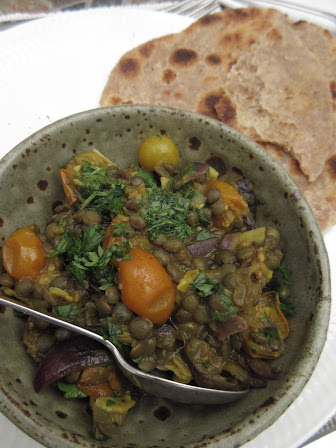


First in the same small frying pan that heated up the spices and melted the butter, I fried up a red onion cut into moons in a little oil: any colour will do, I just happened to have a red onion.  Then as it was started to brown, two cloves of garlic, and a thumb end sized bit of ginger both very finely chopped was added, together with a couple of teaspoons of fresh garden thyme, and a dessertspoonful of ready ground marsala curry powder.  It was stirred as it warmed through in the little oil together with the onions.  I put the lid on from time to time, as it needs to steam as well.  

After a minute or so of stirring, in went the pot of lentils and several tablespoons of the the roasted tomatoes, a little salt too.  A little water just to just a little wetness, rather than adding more oil. This techniques is called fricassé and they use this to cook greens, fish and many other things. This section will only take five minutes or so.  It can be warmed up if making your flatbreads is taking a little longer than you thought. As for variations, they are infinite.  Have you a few peas from the garden, some spare chickpeas left in the fridge, etc etc?

 About three minutes before serving a good amount of fresh parsley went in, with a little left over to garnish the dish when served. Coriander leaves are better, but I had none!

A lovely fresh salsa or fresh chutney with a few chillies in would have been ideal, but I didn't have the right ingredients, so just mixed some lime and mango chutney together to add a little zing. The way you eat this is really by tearing a piece of flatbread, topping a spoonful of the lentil mixture then adding a little topping of chutney, a little like one would eat  poppadums with the pickle tray in an Indian restaurant, with your hands!


Friday, 15 July 2022

Home Made Hot Green Pepper Sauce

I do like pickles, sauces and condiments. I love to make most of mine, but I do enjoy food markets, delis and being inspired by good chefs when we eat out.  Last year we picked up some excellent sauces made by Chef Antonio Paladino who also runs an enterprise promoting aquaponics.  Some time ago he came and gave our gardening group a talk on the topic.  He uses much of his produce to make into gourmet items, and we really enjoyed his Red Pepper Sauce and a Spicy Green Pepper Sauce.  I even kept the bottle with the label on in my empty jars cupboard to remind me of it.  

I happened to have picked up three large green sweet pepper at the market on Wednesday with a view to 'recreating' this sauce.  I trawled the internet for a recipe, but just could not find one which matched my expectations.  I was a little despondent but then pulled myself up by my own bootstraps, a saying my mother used to use.  I have made sauces before, for instance this favourite roasted red pepper and chilli sauce, of which the recipe is over on my other blog.

Using the ingredients listed on Antonio's bottle, I went ahead and imagined the best techniques.  I did not think roasting would suit the flavour.


I took the three large peppers, washed them, and then destalked, deseeded, and cut it into chucks.  Then I used one and a half medium sized white onions, and chopped them up, together with two small green chillies per large pepper, deseeded etc. With about a tablespoon of oil, and with the lid on' the lot was then slowly braised for about ten minutes.  At that stage it was late.  Why do I start these things late at night? I just turned off the heat and walked away.

The following morning, I  chose three  cloves of my new season garlic, added that to the onion and peppers, and slowly braised for a further fifteen minutes checking that nothing was browning or catching.  How much vinegar or sugar to add?  I decided at first to add just about enough to come up half way amongst the peppers, and cooked for a further ten minutes, with the lid off.


Just how much sugar and salt to add?  The best way is to taste, so I allowed the mixture to cool down after they had a good blitz with my hand held whizzer.  Had I a food processor then I would have used it and probably also sieved it.  No I do not wish for that contraption, or to wash a sieve afterwards.  I also felt it could be a tad hotter, so a further two small green peppers, were added and the whole cooked for a further ten minutes, before having a final blitz. with a little virgin olive oil. about 1 tablespoon full.  I suppose each pepper has a level of heat, and each person knows their own favourtie heat setting as far as sauces are concerned.

Gradually tasting I found about a dessert spoon of white granulated sugar per large greenpepper, and about a whole teaspoon of sea salt for the whole lot was perfect.  I did however feel there was something missing.  The original condiment used white malt vinegar, but I used my local Cider Vinegar.  I added the juice of a lime and its zest. It all needed just a little more cider vinegar to get to the right consistency, and another few minutes simmering.   

Oh my!  Perfect!  Everything was thoroughly heated before the bottles were filled and sealed.


 I don't have sufficient bottles at the moment, so a little sealed jar was filled.  

I can't quite say this is a recipe, but I think there are sufficient guidelines for this to be recreated.  We are going to visit the Farm as part of the Food Festival, and there will hopefully be other lovely sauces to buy, and maybe I will just be able to gather any hints.

Monday, 11 July 2022

Celebrating the last of the peas and Colin's Apple 'Molasses'

 Yesterday, very early, before the sun came round, I decided that the peas would probably not survive the several days ahead when we have very hot wall to wall sunshine, heat and no rain.  We've been having picking from the mangetout for several weeks, just from a shortish row, and also from another so called dwarf pea but which much have been 1 metre tall at least.

I often 'celebrate' the first of the veggies, and I thought why not the last of the peas. I sorted out whatever I could from the clearings which yielded a few salady snippings which will garnish a salad today, a few mange tout to be used again for dinner to day.  I did all this 'mindfully' appreciating the beauty and the colour and the produce a very small patch can yield.


Some pods has escaped picking and would be hardish, so I decided the peas could be added to a slow cooked dish and I just happened to have pork belly slices in the fridge.  Some onion, chopped celery and carrot together with an assortment of garden herbs made up the dish.

The greatest flourish was as a result of trying to work out what I could add in place of cider, which was not available, and really it was too hot to go out shopping.  I just used water but for the last half an hour when the top was removed I brushed the edges of the pork with Colin's preserve.  The inspiration came from a dish that we had at a Palestinian Pop up in Wells where pomegranate molasses finished off  a dish which included slow cooked lamb.  Imagine 'Apple Molasses', this jar will be used as such rather than on toast!

When Colin and Julie last visited, bringing with them a couple month's supply of apple juice and apple cider vinegar, they brought a little jar of a preserve which Colin makes. Julie tried to explain what it was and said don't worry if we don't like it it was his sort of 'jam'. We love it that now Colin and Julie stop by and have a chat and tea and cake, before they return to the farm.  We talk about food, gardening, knitting etc etc. It is just such a relaxing way to sit in the garden and talk with friends.

I think Colin's preserve is almost pure boiled down apple juice or maybe it is cider.  It will sure to be a great topic when we next meet. It must be over a month since they visited, and the jar had been brought out for our toast a couple of weeks back.  It was unlabelled but had been put in the cupboard, next to my 'vintage' lime marmalade also unlabelled. and had been brought out as that to the table.  It was tangy like a lime marmalade but not set firm, and went beautifully on home made sourdough toast.  We even discussed how the lime peel has gone so very soft and was now imperceptible, in fact melted into the matrix.  Several days down the line, it was toast again, and having spread my slice and having had a bite, I quickly grabbed the jar away from the jam and marmalade monster aka Mr Stasher.  I had realised this rare and wonderful preserve was from the Combens.  Oh Joy!  I have a new special ingredient to experiment with. I must try to barter another jar out of  Colin! Of course if he reads this he may well have added this to farm produce and can be something we can purchase, Anyway they are coming to dinner soon, and I am not sure whether to do this dish or one with lamb?

Oh yes, the peas were a lovely addition and well worth the effort to sort through the 'straw' and find the peas. 


Monday, 18 February 2019

Date and Walnut Cake

On Saturday I baked  Date and Walnut Cake, a version of which I devised for the schedule for my first gardening club.  When I moved and joined another gardening club this was added to their schedule under the heading:  'Baked by a Gent'.  Baked several times over a month fefore the competition, and members told me just how much they loved this recipe, and that is was already a firm family favourite.  The chaps really were very keen, and knowing that there would be none of the usual lady members who had years of experience to worry about, threw themselves into the challenge.  My current gardening club is strictly Plants but I think I shall bake this for one of the get togethers that require refreshments...it is so very easy!

I had not baked this Date and Walnut Cake for years.  Other Date and Walnut tray bakes exist on this blog, but I wanted to bake something that was easy enough to carry at the bottom of my bag.  The original with a few tweeks, such as roasting of the walnuts and addition of my signature spice, is really the best of all.

Yesterday I was being treated by gardening friends to a day out: visiting another 'Garden Great'.....more about this to follow on the next post.  Of course, I love to take something as a 'Thank you and  shall we share'.

I like to bake this in a '2lb Loaf Tin'....strange that we have had grams yet baking tins are still measured this way, and always line my tins with baking parchment for cakes.  Preheat the oven  to 160 C, and reduce this to 150 C after ten minutes, for an electric fan oven.

200g Dates chopped, the hard dried ones for baking
1 tsp bicarbonate of soda
1 pinch of salt
280ml boiling water

Put all of these in a bowl, and continue to prepare the rest of the ingredients as this stand cooling

60g walnuts kernels...which are gently roasted, at about 150 c for 5-7 minutes, chop coarsely when cool

250g self raising flower    flour, sifted with
1 tsp ground Mace
110g butter, I use goat's butter, but cow's butter will do fine

Rub the fat into the flour/spice to fine breadcrumbs, then stir in the chopped walnuts

110g light Muscovado sugar...only the best such as Billington's should be sifted over the flour butter mixture, to ensure there are no lumps, and this also helps distribute the sugar evenly when it is folded in now.

To the above, fold in the cooled to around 35 C Dates and Water, and

1 Large Egg

Carefully move to your lined tin, and sprinkle the top liberally with Demerara Sugar

Bake in the oven, watching carefully for around 1 Hr  15 Minutes. It should not catch so cover with baking parchment if necessary.

Leave to cool in the tin for about 15 minutes, then remove but keep the paper on to continue cooling on a rack.  Remove paper only when completely cold.  Wrap in foil for transporting or freezing.

We all loved the cake, and I was impressed that John asked which spice was in the cake as he could not exactly work it out.  I was also flattered when he asked for the recipe, so here it is....enjoy!

After coffee and cake, John and his lovely two dogs lead us out to look at some of the many beauties in the garden.  I had visited previously in June of 2015, and as I love gardens in Spring really enjoyed seeing John's garden at this time of the year.


Friday, 8 February 2019

Almond and Pistachio Petit Fours

One of my favourite flavours is Pistachio.  When in the Mediterranean, the first ice cream has to be a pistachio flavoured one.  Today I wanted to do a little baking, partly to have something to take when visiting friends this evening, and partly to have a little store/stash of these dainties.


I call these petit fours.  In Italy and specifically when admiring the trays of tiny nut biscuits in patisserie windows, I would call Mr S just to look at them.  They have all sorts of local names ranging from Ricciarelli, Cavallucci or just 'Macaroons' .  The little I know about such 'nutty' biscuits is that they are delicious. 

These nutty biscuit are just the thing to have after dinner,  when no dessert is needed, but lovely with a little thimble full of liqueur.

Here is my original recipe for

Almond and Pistachio Petit Fours

50g shelled pistachios

200g ready ground almonds

100g icing sugar

25g very finely chopped candied lemon peel

1/4 tsp almond essence

2 egg whites

1 egg yolk


First:  if the pistachios have a skin, cover them in boiling water, and removing a few at a time, remove the skins.  Put the skinned pistachios on a board and chop.  Its good to have varying sized pieces so it is best not to do this in a processor, where there is a danger of getting too fine pieces and too much oil coming out of the pistachios.

Preheat the oven to 150 c Fan, and line a couple of strong baking sheets with baking parchment.


Whisk the egg whites until light and fluffy, but not dry.  Add two thirds of the icing sugar sifted, and whisk well again.

Add the very finely chopped candied lemon peel, and whisk, to ensure even distribution.

Add the almond essence and egg yolk, and mix in the egg whites.

Add the remaining ingredients except for a couple of teaspoons of chopped pistachios, which will be used to garnish the top of the biscuits.

Leave to stand for about ten minutes.  During this time the dried almonds will absorb some of the moisture.

Have a small bowl of water into which to dips your hand, as moist hands makes shaping the mixture far easier.

I weighed my biscuit dough to about 18g, shaped them into a ball, and put them on the parchment.  I got 32 small biscuits.

Left them a further 15 minutes at room temperature, then popped them in the oven.  Watch them and turn and change shelves to ensure a pale even colour.  It took 20 minutes for them to bake.

Remove from the oven and the leaving them on the parchment, remove the trays, and place the parchment and biscuits on a cooling rack to cool.  After five minutes remove the parchment and continue to cool.  Store in an airtight tin....and enjoy!


Sunday, 30 December 2018

Pumpkin bread sticks recipe

A few weeks ago I made some bread sticks for a buffet meal at our local gardening club, and found the technique so useful for keeping bits whole and interesting, but within the confines of the dough.  Here I offer up a savoury pumpkin dough finger bread, which can encapsulate various bits and pieces.  The possibilities dependent on ingredients available and your taste.  I do like the taste of Nigella Seeds, and with the pumpkin dough they work very well.  The addition of coriander is a great taste, but for those who dislike that herb, may I suggest oregano, or sage?  Roasted red pepper scattered over grated goat's cheese is also an excellent filling.

SAVOURY PUMPKIN AND CHEESE BREAD FINGERS


300g Roasted pumpkin
50g good olive oil
1 egg
12g salt
2 tsp nigella seeds
100g polenta uncooked or maizemeal
550g white bread flour
20g fresh yeast mixed with 50g water

 200g of your cheese of choice, I used strong local cheddar the real Cheddar Cheeese from Cheddar
A good handful of coriander leaves
50g sunflower seeds, set to soak just before kneading the dough, to prevent scorching
Egg wash
Black sesame seeds
Cayenne Pepper


First wash and chop, and cook your pumpkin by baking it in the oven in even sized chunks.  Then as it is cools enough to handle, cut off the peel and remove the seeds.  You can freeze any left over, or keep it in the fridge ready to use another day.   I like to bake my pumpkin the previous day, and mix the dough in the morning, then bake by lunchtime.

Into a large bowl, sift the white flour and the polenta to incorporate air, tip anything left in the sieve into the bowl.

Add 300g of the prepared pumpkin to a small pan, add the olive oil, and warm gently to about 40 C.  Either mash well, or if you have a hand-blender, reduce it to a smooth-ish puree.  Add the salt, and the nigella seeds, then add the egg, and mix well.

Add the contents of the pan to the wheat and maize mixture, then add the fresh yeast and water mix, add a little more water to bring everything together to a kneadable dough.  Knead for about ten minutes by hand, then leave to rise for about 1.5 hrs.

Roll out the dough to a long oblong.  Here it was about 80cm x 30cm.  You will need to keep the work-surface lightly floured to prevent sticking.  Scatter the toppings as per the picture, then fold the bottom third up, then the top third back over.

I use my steel scaper, or you could use a knife, but be careful not to damage your work-surface.  Cut thin strips.  This quantity yields about 36 bread sticks or finger rolls.


Have two or three baking sheets, covered with baking parchment, ready to receive the twisted sticks.  As you twist them, you may stretch them to the length that suits you.  Place the the tins covered, to rest, for about 45 minutes.

Preheat the oven to 220 C.  Brush the sticks generously with egg glaze then scatter the sesame seeds on half and cayenne pepper on the rest.  The black sesame seeds give a good colour contrast with the yellow pumpkin dough and green herbs.


Bake for about 15 minutes, then place on a cooling rack.  They freeze very well, and are lovely served warmed up.


Monday, 8 October 2018

Nut and Date Traybake Recipe

Mr S from time to time,  goes off to play trains.....model trains....and sending him off with a box full of cake or biscuits to sustain the gang has become part of the routine.  Each time I opt to bake something different.

On this occasion I wanted to bake the Date and Walnut Loaf recipe which I had devised many years ago for a baking category for the Autumn Shows of two gardening clubs.  It was always a hit, and  many people entered the standard recipe, and said that they had baked it many times since.  I just couldn't find it...having spent nearly two hours trying to find it, and finding other things I didn't know I had misplaced, gave up, and felt rather despondent.  (Today I have found the recipe by trawling through my computer files and finding it on the Show Schedules....)

However comparing the loaf recipe with my adaptation of a previous Date and Walnut tray-bake, they are really quite different.

This recipe inspired by one of Mary Berry's recipes, makes a large traybake.  This cake is best left a day or so to mature before cutting and eating.

Mr S took a section, and I took some to share with with Alison.  There was still another section left over!  However each time we are cutting smaller slices......


Nut and Date Traybake 

250g stoned and chopped dates...I prefer the hard dried ones for baking
50g butter, I used goat's butter, but any good butter will be fine
350 ml boiling water
2 large eggs
150g ground almonds
150g chopped walnuts...I like to lightly roast the walnuts for about 7 mins at 150 c, then soak them for a couple of hours in water, which is then drained off with water discarded.
150g dark muscovado sugar
1 tsp finely grated nutmeg, you could use another spice if you prefer, or none at all
350g wholemeal spelt flour, sifted with,
4 tsp baking powder, to mix and add air, putting all bran etc back in.

Pre heat the oven to Fan 150 c, and grease and line with parchment a 30 cm x 23 cm traybake tin.  I use a deep Silverwood traybake tin a loose bottom which makes removing the cake for cooling easy.

If baking in a standard tin increase the temp to Fan 160c

Weigh the dates, chop them if necessary and put them with the butter in a bowl and pour over the boiling water, and any spice, stir, and allow this to cool...

Whisk the eggs and sugar together in a large bowl then add the cooled date mixture, and the rest of the ingredients.  Mix well then pour carefully into the prepared tin.

Bake in the preheated oven.  Test after 50 minutes.  It may need a little longer, checking with a toothpick or skewer to see if it is ready.  The cake should be golden brown.  Allow to cool outside the oven in the tin for 15 minutes or so, then remove from the tin, and place it on a cooling rack till completely cool.

For the topping I made a simple butter cream using 100g butter, 200g icing sugar, with a little apple juice and my favourite panetone flavouring the main note being bergamot.  Any topping of your choice would do.

It freezes very well, but like most cakes, best stored only for up to six weeks.

Monday, 27 August 2018

Perfect supper dish...

Baked butternut squash with hazelnuts, goat's cheese and herbs: we ended up with half left and reaheated next day for lunch.


I've had a comment from one of my IAVOM buddies about a recipe.  Its from Good, Good Food by Sarah Raven.  Sarah Raven is a leading light in gardening in the UK, and she also likes food, and she was a Doctor.  There are some superb recipes in the book, in addition I have found the notes on nutrition and health very informative.

I am a bit of an intuitive home cook, and am inspired by reading cookery books, but don't necessarily follow recipes.  For my version of Sarah's Stuffed Butternut Squash, I sliced it in half, left the seeds in, then popped it on a baking sheet in the oven at 180C, having first wiped some oil over the surface.  It took about a hour to get soft.  Of course, whilst this was happening, I was busy in the garden!

After discarding the seeds, I used a desert spoon to scoop out most of the flesh into a bowl.  There I just mixed in some green olives stuffed with lemons, and cubed up some goat's cheese, added plenty of pepper, and chopped and sliced rosemary and sage.  I had soaked the hazelnuts overnight, then tossed them in some ras el hanout, you could use any spice, or no spice, and dry roasted them in the oven for about 15 minutes whilst the butternut squash was roasting.  I then put the stuffing back in the shells, making sure the cheese was more or less on top, so that it could brown a little.

I had roasted 100g of hazel nuts but felt that was too many...planning to make a small batch of pesto with herbs for pasta later in the week, with the remaining.

When out of the oven, a gentle drizzle of olive oil, more hazel nuts and a sprinkling of dried ground seaweed.

The olives, spice, seaweed were my additions, and since I didn't have any soft goat's cheese at the time, used hard cheese.  You could do something similar with sweet potatoes.  Runner beans picked minutes before were from the garden.

If you make this..and love fresh tasty food you are bound to love it.  As a waste not want not...left over could be blitzed and made into a soup!  Roasted butter nut squash and cheese soup!

Wednesday, 8 November 2017

Spelt and Apple Cake

A few weeks back I made a cake, I remember that it was delicious, and also that I had used spelt and not the flour suggested in the recipe, almonds, apples, and had added to the recipe a handful of raisins.  I had not written my changes in my book, but I did remember which book I had been reading at the time: Short and Sweet by Dan Lepard.  The flavour of the cake changed over the days, maturing...it was very good on day one, and still very good on day 4!

Mr S is off to do a session of archery with his new pals this morning , and I thought to send him off with a cake to share at coffee time.  Since his host had very generously supplied us with some apples from his orchard, this cake would just meet the bill.

As a whole I much prefer cakes without butter cream or icing, and when I was looking for an apple cake this recipe of Dan Lepard's had a different and very easy technique.  Next cake bake I shall try the recipe exactly with the Rye Flour.  Again another question and the possibility for two variations: white rye flour or wholemeal rye flour?  If I have not picked up any rye flour, I shall probably use sifted wholemeal rye which I always have in store for the sourdough base.

Here is my variation, but to read the technique see the link to Dan Lepard's  recipe for Rye and Apple Cake published in the Guardian.

1 Medium Apple, washed, cored, and chopped small
1 tsp cinnamon
75 almonds, I used 50g ground for the cake, and 25g flaked for the topping
150g spelt flour
2 tsp baking powder
75g goat's butter
A mediumly generous tablespoon of golden syrup
About 75g raisins from my pot of raisins soaking in Calvados
100g Billington's soft light muscovado sugar
75ml goat's milk
2 medium eggs
Demerara sugar

I slightly upped the above for instance 175g spelt 85g butter, 120g sugar etc as I wanted to have two 500g tin cakes.  After all, I wanted a cake to have at home!


Saturday, 23 September 2017

Cake in Moderation

Usually Friday is bun day!  Ever since I baked nearly all the recipes in Jane Mason's Book of Buns, this has been the rule.  Either fresh or from my stash of frozen buns, two are served on lovely white china with a pot of tea on Friday afternoons, and if friends can pop in then, they are of course included.

We missed out on buns last Friday, and we were to have cake on Sunday at the pump rooms in Bath, but the queue was unbearably long.  We planned to pick up a cake or bun somewhere on our way back...but we were turned away at 4:02 because Morrison's close at 4 on a Sunday and were just letting people leave, not enter.

Mr S requested very nicely  cake and tea instead of buns and tea this Friday.  He wanted a cake like the granny cake we used to buy from the COOP on Fridays on the way home from work from the COOP.  I'm not talking about the large birthday cakes or sticky confections that are available these days.  The cake was a rather plain, lightly fruited affair with bits of sugar on the top. This was over 20 years ago!  The cakes were rather small, but quite tasty and came in a square box that made them look bigger than they were.

I wanted to make a cake as close as possible to the one we had years ago.  I looked for a 'frugal' type of cake recipe, but ended up devising my own.  The next problem was size, all my cake tins are 'ample sized', and making a frugal fruit cake in a small 1 lb fruit tin would not have looked like the one we used to buy.

I just could not get out of my head my 'contretemps' with Kenco in August, which I posted about on facebook, and recently copied here for my friends that are not on facebook.  If people are having smaller cups of coffee, then 'moderation must be 'en vogue'!  So I bought a small round baking tin....Here is the small 6 "cake tin which is still not as small as the standard 5" cake currently being sold in Sainsbury's!  If we cut the same number of slices from a 15 cm cake rather than 20 cm cake and had that with the 'smaller' cup of coffee, we can still have cake and coffee despite the recent hike in prices in the shops!!!!!!  Both are much smaller!!!


With this smaller cake tin...and thanks to Kitchen Craft the manufacturers they have printed the size in inches and centimeters on the outside, such a brilliant idea, I baked the following....

6 Inch Frugal Fruit Cake to be enjoyed in Moderation

200g self raising flour sifted
1/2 tsp mixed spice sifted with the flour
100g butter
100g caster sugar
150g mixed dried fruit
1 egg
75g milk or thereabouts
Coarse Sugar to sprinkle

Rub the butter into the flour and spice, add the caster sugar and mixed dried fruit, stir well to distribute the fruit.  Crack open the egg into a small bowl and mix with 50g milk, stir this into the main mixture, then gradually add the remainder of the milk to a stiff but not dry constituency.
The fruit was a mixture of raisins, currants and my home made crystallized orange and lemon peel.

Bake at Fan Oven Temp 160/ Gss Mark 3 for about forty minutes.  It may take less but watch, and cover after about 25 minutes to avoid scorching, and test with a skewer to check that it is fully baked, before removing.  Leave in the tin for a few minutes then turn out onto a cooling rack.  Eat only when completely cold!


Friday afternoon tea and cake time, with a neighbour invited over so that we could plan our joint order for autumn mulches for the garden.


Wednesday, 8 March 2017

Arkatena Bread

I am going through my stores and finding recipes to use up the ingredients which are close to the best before dates, and I have some chickpea flour....Andrew Whitley's Bread Matters Book came up trumps.  I read the recipe and felt that it would take a little too long for me, as well as making a largish batch of production leaven where not all was used.

These ratios and timings suit me.  The resulting loaves are delicious.  I baked them in two 500g oval bannetons and the picture is of the loaf that got stuck in the banneton...hence its rather rustic looking top.


Early afternoon of day 1

50g sourdough white starter..100% hydration
25g chickpea flour
25g white strong flour...my current batch is stoneground organic strong white from Stoates
50g water
150g starter in total

mix and place in a bowl and keep covered on the worktop

Late evening day 1

150g starter from the above
50g strong wholemeal
50g chickpea
120g water
520g total Production Leaven

Mix and leave the bowl covered on the worktop

Day 2 Early morning

100g strong wholemeal
300g stron white wheat flour
10g sea salt
300g water
20g fennel seeds
520g Production Leaven
1250g dough in total

Knead the dough well for about 10 minutes, and then leave on the worktop under an upturned bowl for about a hour.  Stretch and fold, then leave for another hour, repeat again!  Its well worth developing your sourdough techniques.  Thanks to several months working on doughs into the Perfecting Sourdough Challenges on Facebook, and exchanging tips there, I have come a long way.

Divide as appropriate to fit your baskets, then prove for a couple of hours or so depending on ambient temperature until the finger tests show that the loaves are ready to bake.

Preheat the oven to 220 C, bake for 10 minutes, then reduce to 190 C fan and bake until ready about 25 minutes for 500g loaves.

The bread is rather delicious...nutty and nutritious.  Nice toasted too...great with cold meats, chutneys, roasted veg and hummus.

With 250g of the dough left after two 500g loaves, I mixed in some soaked fruit, spice, and the soaked bottom of the fruited all bran breakfast cereal bag, and left the mixture to rise in some muffin tins...rather delicious upcycled breakfast cereal, the dusty small bits which would have gone in the bin!  I got six nice fruity breakfast buns.

Sunday, 22 January 2017

Somerset Spelt Apple and Cider Cake


When I was deciding what to bake for the first visit of our beloved family, I wanted to find a really local recipe.  I tried books, and I googled and only just now have found a recipe for Somerset Apple Cake which I shall try in a week or two..or course with a twist or two.

I was inspired to develop a new recipe based on the bounty of our new County...just down the road at Shapham Park farm they are now growing Spelt, we have wonderful orchards of apples with numerous varieties at the Wells Market and just beyond Cheddar is the Cider Maker Thatchers.  We have sourced wonderful honey and local free range eggs.

Ingredients

1 small eating apple, cored, then diced small with the skin still on 
1/2 tsp ground mace
150g light spelt flour
50g ground almonds
2 tsp baking powder
75g Delamere goat's butter
50g honey
100g light muscovado sugar 
60g raisins
75ml cider
2 medium eggs
Flaked Almonds

Soak the raisins in the cider for a few hours or overnight.

Toss the prepared apple in the ground mace.

Add the spelt flour to a large bowl, together with the almonds and baking powder.  Add to this the cold butter and rub it in till the mixture looks even and like fine breadcrumbs.  Add the light muscavado sugar and mix till evenly distributed.

Mix the honey into the cider and raisins, the mix in the eggs gently till you have an even mixture.

Add the honey, cider, raisin and egg mixture to bowl containing the spelt, almond and butter, and stir till even but don't stir too much!

Gently pour into a 500g loaf tin which has been lined with baking parchment.  I used my slightly large Silverwood tin, which gives nice wide slices.  There is no reason not to bake this as a tray bake either!

Bake in a moderate oven...I used 160 Fan in my new oven!  It took about 40 minutes till a skewer came out with just that little bit of moisture which means the cake is done but not overdone.  For the last fifteen minutes I covered the cake with some parchment to stop the almonds from scorching.


Most of the cake was eaten on the day of the visit, and very much enjoyed.  I'll be baking this one for all new visitors so be warned...it is  lovely with a dollop of clotted cream or local organic sheep's yogurt when I can get it.  If it isn't in the market that week, I may just get you to cycle across a couple of miles of beautiful countryside and pick some up from Wootton Farm. Mr S prefers goat's yogurt...and his favourite is Delamere's which Morrison stocks.

Friday, 28 October 2016

Pumpkin Cake with pumpkin seeds recipe

This morning, I found a lovely bag of large cranberries in the freezer, and looking through my books for inspiration, settled on making some cranberry chutney, with red onion, apple, and cider apple vinegar, with a mixture of festive spices. It will not need refrigeration, and will be nicely matured for Christmas.

I've also finally baked theTurk's turban pumpkin which has been adorning the conservatory for the last few weeks.  It had got jolly hard, and I had to have a second pair of hands to break it open.  I simply placed the quarters skin and all in the oven to bake, and when soft scooped out the flesh.

There are no pictures...a small piece of the cake was cut off to eat, and the rest went into the freezer! Its going to come in very handy in the next week or so!   I am very busy using everything up.  I know what needs to be used from the freezer, fridge, and store cupboard, and ideas just appear from somewhere.

As well as making the cake, today I made up buns with pumpkin flesh, strong flour, home candied peel, the remaining of the preserved ginger, aniseed, butter, milk, yeast, eggs etc.

I've been sorting out recipe books, magazines, my card index box and hand written recipe books which date back many years, when I came across a typewritten recipe for a pumpkin cake...and it was from this that I have developed the Pumpkin cake below.  The original recipe which had margarine and walnuts, used the creaming method, and had a different blend of spices, and far too much sugar for my taste buds now.  Joyce Hatwood had brought some of her pumpkin cake to a crafting session about six years ago and it was so delicious, I asked for the recipe. I've been on a mission to eat more pumpkin seeds as they are high in zinc, and yes that's another item which needs using up!

Mr S has also been on the use up path, and when I emptied the teapot in which he had been brewing his spicy chi...I knew that would make a lovely soaking liquor for the raisins...I've kept back some of the last teabags to use for soaking raisins in during the next few days.

Pumpkin Cake with Pumpkin Seeds

225g plain flour...I used white spelt flour
1tbsp baking powder
175g soft brown sugar
225g cooked pumpkin flesh
75g butter, I used goat's butter
150g Raisins soaked in strong hot chai tea...enough to hardly cover the raisins
50g chopped candied peel
A good handful pumpkin seeds
1/4 tsp ground mace
1tsp ground cinnamon
1/8 tsp ground cloves
2 large eggs

You could sprinkle the top with some demerara sugar and more pumpkin seeds, but may need to cover part way through baking to prevent these scorching.

Sift all the dry goods, add the sugar, and rub in the butter.
Add the drained raisins and the orange, mix eggs into the pumpkin puree, then add this to the mixture, with the pumpkin seeds.  Stir well, and add sufficient of the soaking liquid to give a softish texture.

Bake in a lined 2 lb loaf tin for 60 to 70 minutes in a preheated oven gas Mark 4.  Test with a skewer.  Cool in the tin for about 20 minutes, then turn out and cool on a rack.  The cake is very tender, and it is best left till completely cool if you want neat slices.

One of the tips on the guides to making the removal process as smooth as possible is ensuring there is plenty of tea and biscuits...well there will be buns and cake!