| Crocus chrysanthus 'Romance' |
![]() |
| Galanthus Trumps |
![]() |
| Oxalis triangularis rhizomes accidentally uncovered |
![]() |
| Crocus minimus Spring Beauty |
| Crocus chrysanthus 'Romance' |
![]() |
| Galanthus Trumps |
![]() |
| Oxalis triangularis rhizomes accidentally uncovered |
![]() |
| Crocus minimus Spring Beauty |
In these parts do trees grow, around which myths and legends abound. Many myths, legends, and much speculation has grown up around a Hawthorne which grows in a stunted way. The best information about this tree I found can be read on The Garden Trust Blog.
![]() |
| Glastonbury Parish Church with The Glastonbury Thorn |
I have read that neither cuttings nor seeds can be used to propagate the tree, and that it has to be grafted.
![]() |
| Flowers in January as well as haws from last year's flowers |
![]() |
| Lichen and moss encrusted criss cross of twigs |
I first wrote about a similar Hawthorne two years ago, and for this week's Tree Appreciation Tuesday, I took pictures last week of the Hawthorne outside St John the Baptist, the COE Parish Church at Glastonbury.
This particular tree just represents for me, the mystic and mystery which can build up regarding either one particular tree or a tree type or maybe a tree in a particular place. It could be that a tree has particular meeting for just one person, a group of people, a tribe, the fact that trees enter the psyche of people is not surprising. The Glastonbury Thorn has been written about, and stories spun around it. This is quite ironic given that almost all the specimens of 'The Glastonbury Thorn' are not likely to be more than a hundred years old.
Whether in ancient times or now, starting up stories which appeal, or entertain, has been of value to religious places, business and commerce. From the Glastonbury Abbey webpage:
Many believe that the Holy Thorn tree that can be seen in the grounds originated from the staff of Joseph of Arimathea.
By the 1530s, not long before the Dissolution of the Monasteries, three thorn trees grew on Wearyall Hill (sometimes known as Wirral Hill) about 1km south-west of Glastonbury. The trees were very unusual because they flowered twice - once in the spring around Easter, and a second time at Christmas.
Not surprisingly, they were seen as holy thorns. In the Civil Wars of the 17th century Puritan soldiers cut down the only remaining thorn because they saw it as an object of superstition. However, local people had kept cuttings, and it is from these that the thorn now growing in the abbey grounds is believed to descend. It continues to flower around Easter and again at Christmas.
The custom of sending a budded branch of a Glastonbury thorn to the Queen at Christmas seems to have begun in the early 17th century, when a branch was sent to Queen Anne, King James I's consort. A spray is still cut from the thorn in St John's Church yard and sent to the sovereign each Christmas by the Vicar and Mayor of Glastonbury.
The thorn featured on British 12p and 13p Christmas postage stamps in 1986.
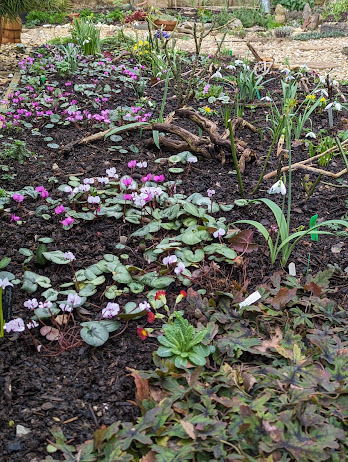
Snowdrops and Cyclamen coum are coming up in the garden. They make good bed fellows, as the coum corns are relative small, and the leaves not as extensive as the C. hederifolium.
This week's little arrangement consists of a number of the named varieties. I had picked these as I had a number of friends come round for coffee and cake(s) on Friday. We sat in the conservatory, but that is where they chose even though we were packed in there. I had quite a few compliments about the garden, most had not seen anything other than the Nivalis, and enjoyed viewing the differences close up in the little vase.
Again another charming and different snowdrop is Galanthus Diggory. This was a gift several years ago from Anna, and the outer petals curve in and are pleated reminding me of seersucker fabric.
The garden plants has more or less been standing still during the last week, but I have been doing a little repotting, and moving around of plants. For further interesting reading on matters garden or gardening, Six on Saturday anchor blog is the place to go to.
As I looked back over previous years, I realise that each year I had been attracted to 'yellow' in the garden. Last autumn I bought some Crocus chrysanthus 'Dorothy' from the Potterton's stall at the Bishop's Palace in Wells. Jewelled with moisture on this grey and gloomy day, they draw me to the sitting circle table on which some of the smaller pots of early flowers have been placed. The dark purple streak on the outside of the petals particularly appeals to me. The crocus in the ground have been slow to emerge this year, with one or two are valiantly showing promise.
2. Other spring beauties that I am trying to establish in the conservatory bed are Eranthis. In February 2024's edition of Garden Illustrated, there are several pages dedicated to what we call 'Winter Aconites'.
I mentioned last week that I had planted a new one: Eranthis hyemalis 'Winterzaube' 'Winter Magic', and ones planted in 2020 are just at the stage of their showing their position. A little further away is a plant which has been moved several times, but I think this came in soil in a pot brought from my last garden. It forms a neat clump of several blooms.
3. On the couple of decent days this week, a got down to a couple of plants which needed moving.
![]() |
| Cyclamen hederifolium Fairy rings type |
What an enchanting tree and its placement was inspired!
The footbridge across the Bishop's moat, with the small island on which it is growing, allows for a glimpse right into the crown, and a walk right through the drooping branches.
In the summer you are bathed in pale green flickering light, now in the winter you can pause mid way and appreciate the structure of the tree. Look up and there are long side limbs, and look down and the reflections equally enchant.
I noticed in a couple of places where the long stems reached down to the water, they were growing roots and therefore it would be easy enough to propagate. If anyone has a large expanse of water in need of a tree, maybe some enquiries for cuttings to the Bishop's Palace may gain you a little piece of this beauty?
Once in 2020 the Swans nested on the little island and a board had to be put up along the bridge, usually the Palace Swans nest along the bank of the moat further along, but during this period when there were far fewer visitors to the Palace, and when so many places were closed, the Island must have seemed the ideal spot for Grace and Gabriel to build their nest. I remember watching the webcam to see how the eggs and the young chicks were progressing. The things we found to do during the Lockdown! The island is still a place for rest or preening for all the Palace's birds
There are so many wild willows growing on the levels not far away but this is a hybrid.
Salix x sepulcralis var. chrysocoma
Cultivar origin
Golden weeping willow is a hybrid between white willow (Salix alba), which is native to Europe and Asia, and Babylon weeping willow (Salix babylonica), which is native to China, both of which have been cultivated for centuries. The first golden weeping willow hybrid dates to 1888.
Derivation of names
The genus name Salix is the classical Latin name for the willows. The hybrid name sepulcralis means of sepulchres, or tombs, and, like the common name, refers to the trees' weeping habit. The letter x in the Latin name indicates that golden weeping willow is a hybrid species.
These details are courtesy of the site Canadian Tree Tours I found this when I was searching for the origin of this tree, and found the site to be well worth looking through. There is much there to further my enjoyment of the trees I see around me.